
Claims Scrubbing in Medical Billing for Texas Practices
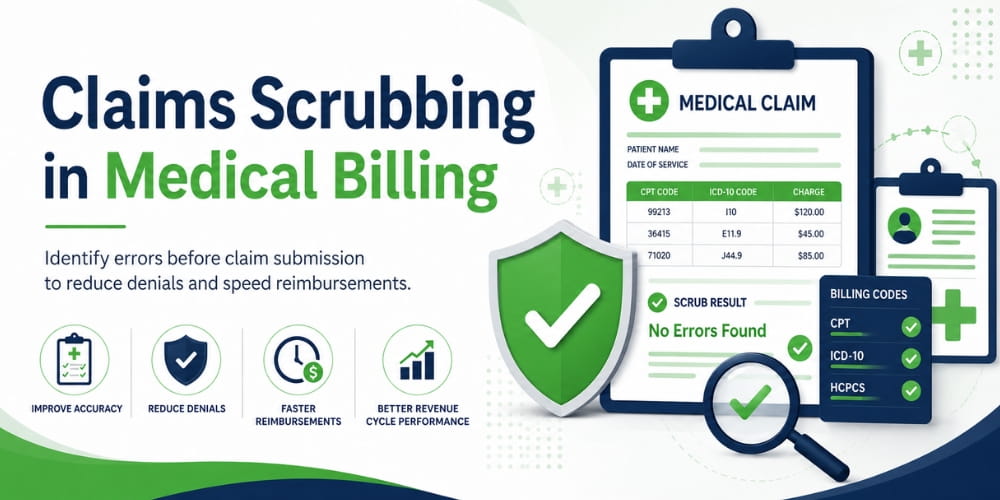
Denied and rejected claims create avoidable work for billing teams, delay reimbursement, and increase pressure on practice cash flow. For many Texas practices, the issue is not only coding accuracy. Problems often begin with incomplete registration data, inactive insurance, missing prior authorization, incorrect modifiers, payer-specific edits, or provider enrollment mismatches. Claims scrubbing in medical billing helps identify these issues before the claim reaches the payer. Claims scrubbing is not a replacement for trained billing staff, compliant coding, or strong documentation. It is a pre-submission quality control step that helps billing teams send cleaner claims, reduce preventable rework, and manage the revenue cycle with more consistency. Claims scrubbing in medical billing is the process of reviewing a claim before submission to identify errors, missing information, coding conflicts, formatting issues, payer rule problems, and documentation gaps. The goal is to correct preventable issues before the claim is sent to the clearinghouse or payer. In practical terms, medical billing claims scrubbing helps answer one question: is this claim complete, accurate, and ready for payer review? A rejected or denied claim requires additional staff time. Someone must identify the problem, review the payer response, correct the claim, resubmit it, and track it until payment or appeal resolution. When this happens across a high volume of claims, A/R aging increases and collections become less predictable. Clean claim submission supports: Faster payer review Lower preventable rework Better billing team productivity More consistent payment posting Clearer denial root-cause analysis More accurate revenue cycle reporting A strong claims scrubbing process starts before the billing team submits the claim. It depends on the quality of front-end registration, eligibility verification, clinical documentation, coding, charge entry, and payer rule review. The process begins when charges are entered from the patient encounter. Billing staff confirm service dates, provider details, place of service, procedure codes, diagnosis codes, modifiers, units, and charges. Errors at this stage can create downstream denials even if the claim later passes basic formatting checks. Eligibility verification confirms whether the patient had active coverage for the date of service. Prior authorization checks confirm whether the payer required approval before the service was performed. Missing or incorrect authorization details can result in avoidable denials, especially for procedures, imaging, therapy, DME, pain management interventions, and ASC services. Medical claim scrubbing should check whether procedure codes, diagnosis codes, HCPCS codes, and modifiers appear appropriate for the claim. This includes diagnosis-to-procedure alignment, modifier use, bundled services, age or gender conflicts, and payer-specific edit rules. Common examples include missing modifier 25 for a separately identifiable E/M service, incorrect modifier 59 use, diagnosis codes that do not support medical necessity, or outdated codes that are no longer valid for the date of service. Many claims pass through a clearinghouse before reaching the payer. Clearinghouses may flag formatting errors, missing required fields, invalid subscriber information, NPI issues, taxonomy mismatches, duplicate claims, and payer routing problems. However, clearinghouse edits alone may not catch every documentation, authorization, coding, or specialty-specific risk. Claims scrubbing can identify many preventable issues before payer submission, including: Incorrect patient name, date of birth, or policy number Inactive or mismatched insurance coverage Missing referring provider or rendering provider information Incorrect NPI, taxonomy, or billing provider data Invalid CPT, HCPCS, or ICD-10-CM codes Missing or incorrect modifiers Diagnosis codes that do not support the procedure Missing prior authorization number Duplicate claims Incorrect place of service Missing accident, injury, or coordination-of-benefits details Timely filing risk due to delayed charge entry Claims scrubbing software can check claims quickly against rules libraries, payer edits, code sets, and required fields. It is valuable for high-volume practices because it flags issues before submission and reduces manual checking. Software alone, however, is not enough for every claim. A billing specialist may still need to review clinical documentation, payer policy changes, authorization history, specialty-specific billing rules, and denial trends. This is especially important for specialties with higher documentation and authorization risk, such as pain management, ASC procedures, orthopedics, cardiology, psychiatry, DME, and therapy services. Claims scrubbing should connect directly to denial management. If a claim is denied after passing pre-submission review, the billing team should identify the root cause and update workflows when appropriate. For example, if denials frequently involve missing authorization, the issue may belong to the front-end authorization workflow. If denials involve CO-16 or missing information patterns, the team may need better registration checks, charge entry review, or provider documentation standards. If denials involve medical necessity, coding and documentation review may need closer coordination. A/R follow-up also benefits from cleaner claim submission. When fewer claims require correction after submission, billing staff can spend more time working aged accounts, payer delays, underpayments, appeals, and unresolved balances. Practice owners and administrators should not evaluate claims scrubbing only by whether software is installed. They should review operational reports that show whether the process is working. Useful reports include: Clean claim rate Rejection rate by reason Denial rate by payer A/R aging by bucket Days in A/R Claims pending by payer Authorization-related denials Coding-related denials Timely filing denials Payment posting lag Appeal status and recovery activity Texas practices often manage a broad mix of payer contracts, patient responsibility balances, prior authorization requirements, and specialty billing rules. A medical billing company in Texas can help practices evaluate where claims are breaking down and whether the issue starts at registration, eligibility, authorization, coding, charge entry, claim submission, or follow-up. Medical billing services in Texas should include more than claim submission. A complete RCM support model should address eligibility verification, prior authorization, coding review, claims scrubbing, denial management, A/R follow-up, payment posting, credentialing support, and reporting. A practice may need outside billing support when denials are increasing, A/R over 60 or 90 days is rising, staff cannot keep up with payer follow-up, credentialing delays are affecting claims, or leadership lacks clear billing reports. Outsourcing may also help when a practice is adding providers, opening a new location, changing EHR or practice management systems, or moving from in-house billing to a more structured RCM process. A careful transition should include account review, payer access setup, clearinghouse review, open A/R analysis, denial trend review, credentialing status review, workflow mapping, and reporting expectations. Advanced IT and Healthcare Solutions helps practices identify billing gaps, reduce preventable denials, improve claim follow-up, and create a more consistent revenue cycle process. The company supports medical practices with medical billing, revenue cycle management, denial management, A/R follow-up, prior authorization, eligibility verification, credentialing support, payment posting, billing workflow support, and reporting. For Texas practices, the goal is not only to submit claims. The goal is to create a billing workflow that catches preventable errors early, tracks payer issues clearly, and gives practice leadership the reporting needed to make informed operational decisions. Practices can request a billing audit or discovery call to review denial patterns, A/R aging, claim submission workflows, and opportunities to improve revenue cycle performance without making unsupported assumptions or promising guaranteed outcomes. Costs vary based on claim volume, software, clearinghouse fees, specialty complexity, and whether claims scrubbing is part of full-service medical billing. Practices should compare the cost against denial rework, delayed reimbursement, staff time, and A/R aging impact. It depends on staffing, payer mix, denial trends, technology, and reporting needs. In-house billing can work well with trained staff and clear processes. Outsourcing may help when the practice needs stronger denial management, A/R follow-up, workflow controls, and reporting. Claims scrubbing reduces denials by identifying preventable problems before submission. These may include missing patient data, inactive coverage, incorrect codes, missing modifiers, invalid provider information, missing authorization numbers, duplicate claims, and payer-specific edit issues. No. Claims scrubbing happens before submission. Denial management happens after a payer rejects, denies, underpays, or delays a claim. Strong RCM teams use denial trends to improve the claims scrubbing process over time. Cleaner claims reduce preventable rework and allow billing teams to focus on aged balances, payer delays, underpayments, appeals, and unresolved claims. This can support better days-in-A/R performance when combined with disciplined follow-up. The transition timeline varies by practice size, payer mix, software access, open A/R, credentialing status, and data quality. A structured transition usually starts with discovery, system access, payer enrollment review, open claims review, and reporting setup. Yes. Specialty billing often requires closer review of modifiers, diagnosis linkage, prior authorization, documentation, bundled services, and payer rules. Pain management, ASC, psychiatry, cardiology, DME, orthopedics, and primary care practices can all benefit from specialty-aware claim review.What is Claims Scrubbing in Medical Billing?
Why Medical Billing Claims Scrubbing Affects Cash Flow
Claims Scrubbing Process for Medical Practices
Charge Entry and Claim Creation
Eligibility Verification and Prior Authorization Checks
CPT, ICD-10-CM, HCPCS, and Modifier Review
Clearinghouse Edits and Payer-Specific Rules
Common Errors Found During Medical Claim Scrubbing
Claims Scrubbing Software and Manual Billing Review
How Claims Scrubbing Supports Denial Management and A/R Follow-Up
Billing Reports Practices Should Review
Medical Billing Services in Texas for Claims Scrubbing Support
When to Consider Outsourcing Claims Scrubbing and Billing Support
How Advanced IT and Healthcare Solutions Can Help
FAQs
How much does claims scrubbing cost?
Is outsourced billing better than in-house billing for claims scrubbing?
How does claims scrubbing reduce claim denials?
Does claims scrubbing replace denial management?
How does claims scrubbing affect A/R follow-up?
How long does it take to switch billing companies?
Can claims scrubbing support specialty billing?