
Electronic Prior Authorization Reduces Denials and Boosts Revenue
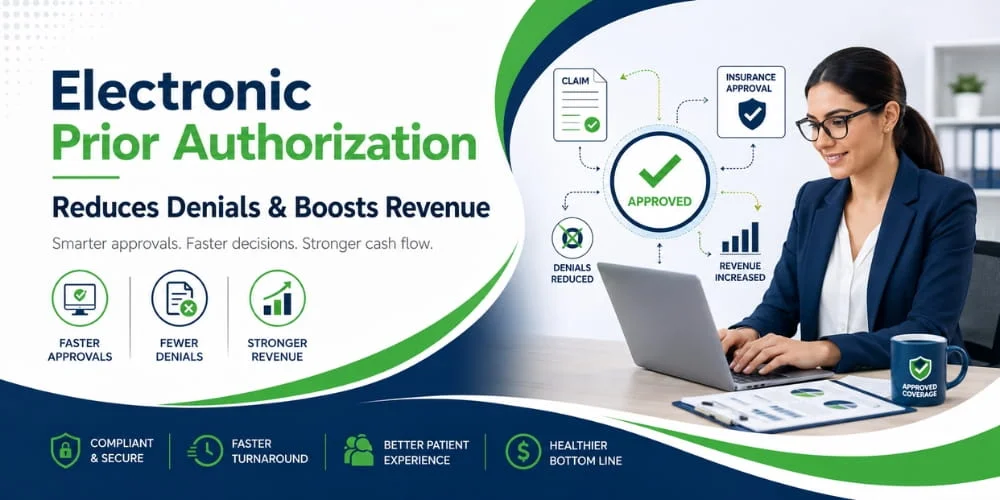
Prior authorization is a time-consuming part of healthcare revenue cycle management. Medical practices may face delayed approvals, incomplete submissions, treatment interruptions, and claim denials when requirements are not managed correctly. According to the American Medical Association, practices complete about 39 prior authorization requests per physician each week, and 93% of physicians say the process can delay patient care. Electronic prior authorization replaces phone calls, faxes, payer portal checks, and paper-based tasks with a connected digital workflow. It helps practices confirm requirements, submit clinical information, track requests, and receive payer decisions efficiently. With support from an experienced medical billing team, it can reduce avoidable denials, improve payment timelines, and ease administrative workload. Electronic prior authorization, or ePA, is a digital process used to request approval from a health insurance payer before certain medications, procedures, tests, or medical services are provided. It reduces dependence on phone calls, faxes, and separate payer websites by connecting providers, electronic health records, billing workflows, and insurance payers. Staff can confirm authorization requirements, submit supporting documents, track requests, and review payer responses more efficiently. ePA does not replace medical necessity documentation or payer review. Instead, it improves information exchange and helps practices manage approvals before services are performed and claims are submitted. Prior authorization is receiving greater attention as CMS moves impacted payers toward standards-based application programming interfaces, or APIs. Some reporting requirements began in 2026, while many major API provisions are scheduled for January 1, 2027. CMS has advised providers and healthcare organizations to prepare before these requirements take effect. Early preparation allows practices to review software, payer connections, documentation workflows, staff responsibilities, and reporting capabilities. It also helps identify which prior authorization tasks should remain in-house and which may be managed more effectively by an outsourced revenue cycle management team, reducing dependence on spreadsheets, faxes, and manual follow-up while supporting smoother implementation across daily operations. A prior authorization approval does not automatically guarantee claim payment. However, a well-managed authorization workflow can reduce many preventable problems that lead to delayed or denied claims. Insurance requirements differ according to the payer, plan, procedure, diagnosis, location, and provider. Electronic workflows can help staff determine if authorization is required before the scheduled service. Identifying the requirement early reduces the risk of providing a service without approval. It also gives staff enough time to collect clinical records, submit the request, respond to payer questions, and inform the patient about possible delays. Missing or insufficient documentation is a major reimbursement problem. CMS reported a 2025 Medicare Fee-for-Service improper payment rate of 6.55%, representing approximately $28.83 billion. CMS identified insufficient documentation and records that did not adequately demonstrate medical necessity as the two main categories behind these improper payments. An effective electronic authorization process helps staff confirm that required information is included before submission. This may involve the diagnosis, procedure details, previous treatment history, test results, physician notes, medication history, and medical necessity explanation. Repeatedly entering patient, insurance, procedure, and provider information into different systems increases the risk of errors. A wrong member ID, procedure code, date of service, provider identifier, or payer selection may cause a request to be delayed or rejected. Integrated electronic workflows can reduce unnecessary duplicate entry. Staff should still review every submission, but improved data exchange can make the process more consistent and easier to track. Manual authorization requests can be difficult to follow when information is spread across fax logs, notes, emails, payer portals, and spreadsheets. Requests may be overlooked when responsibility is unclear or when the payer asks for additional information. Electronic tracking can display if a request is pending, approved, denied, expired, or waiting for documentation. This visibility helps staff take action before the patient’s appointment or claim submission date. When a payer does not approve a request, the practice needs to understand why. The issue may involve missing information, medical necessity criteria, incorrect coding, eligibility problems, or a service that is excluded from coverage. A structured workflow keeps the payer’s response, reference number, submission date, clinical documents, and communication history together. This information supports corrections, peer-to-peer reviews, reconsiderations, and appeals. Artificial intelligence and automation are becoming increasingly important in healthcare administrative workflows. Federal health IT data found that hospital use of predictive AI to simplify or automate billing procedures increased from 36% in 2023 to 61% in 2024. In a prior authorization and billing workflow, automation may help: Detect missing information before submission Match services with payer requirements Assign follow-up tasks to billing staff Identify requests approaching an expiration date Recognize recurring denial patterns Organize supporting clinical documentation Prioritize accounts requiring immediate action Even when a practice uses electronic tools, weak internal processes can still result in denials. Common mistakes include submitting a request under an inactive insurance plan, using incorrect procedure codes, selecting the wrong servicing provider, or failing to confirm if the place of service matches the authorization. Other problems may include: Missing medical necessity documentation Authorization obtained for the wrong date Approval expiring before treatment Changes in the planned procedure Failure to include all required services Incorrect payer or insurance product Lack of follow-up on pending requests Claim details that do not match the approval Electronic prior authorization can support both operational performance and patient service. Its value is strongest when technology is combined with trained staff, accurate documentation, consistent follow-up, and proper claim management. Verifying requirements and submitting complete information before treatment can reduce denials related to missing or invalid authorization. Staff spend less time searching through faxes, calling insurance companies, and switching between disconnected records. When authorization information is correct before claim submission, the practice may experience fewer payment delays and less rework. Patients can receive earlier updates about approval status, coverage limitations, scheduling changes, and possible financial responsibility. Reducing repetitive administrative tasks allows clinical and front-office teams to focus more attention on patient needs and practice operations. Managing prior authorization internally may work for practices with a limited number of requests, experienced employees, strong software, and clearly defined workflows. However, the process can become difficult as patient volume, payer requirements, locations, or specialties increase. An outsourced prior authorization team may help with: Payer requirement research Authorization request submission Clinical documentation coordination Request status follow-up Approval and expiration tracking Denial investigation and appeals Communication with practice staff Medical practices should review prior authorization workflows before new payer requirements take effect. Document who verifies benefits, gathers records, submits requests, tracks responses, and updates patients, then confirms if the EHR, clearinghouse, practice system, or billing partner supports electronic authorization and stores payer decisions. Practices should also monitor performance through measurable indicators such as: Authorization approval rate Average turnaround time Number of pending requests Authorization-related claim denials Expired authorizations Requests requiring resubmission Appeal success rate A professional billing team connects prior authorization with every stage of the revenue cycle. Practices using medical billing services in Texas can improve workflow accuracy, reduce avoidable denials, and support timely reimbursement through: Eligibility verification: Confirms active coverage, benefits, and payer requirements before services are scheduled. Authorization management: Submits requests, tracks approval status, and follows up on pending cases. Coding and claim review: Checks if procedure codes and claim details match the approved authorization. Documentation coordination: Helps organize clinical records and medical necessity information required by payers. Denial investigation: Identifies if denials resulted from authorization, coding, eligibility, or filing issues. Accounts receivable follow-up: Tracks unpaid claims and communicates with payers until resolution. Payer-specific support: Applies the correct workflow based on each insurance company’s requirements. Electronic prior authorization can help medical practices reduce administrative work, prevent avoidable claim denials, improve approval tracking, and support healthier cash flow. Technology alone is not enough. Successful results also require accurate eligibility verification, complete clinical documentation, trained billing staff, timely follow-up, and careful claim submission. Advanced IT & Healthcare Solutions provides prior authorization, denial management, eligibility verification, accounts receivable, and complete revenue cycle management support. Contact our team to learn how an organized billing workflow can protect revenue and reduce the administrative workload placed on your practice. Call us at +1 (469) 454-6966. Electronic prior authorization is a digital process for submitting approval requests, supporting clinical information, and receiving decisions from insurance payers before certain services or medications are provided. No. Approval confirms that the payer reviewed the requested service under its authorization requirements. Payment may still depend on eligibility, coding accuracy, medical necessity, claim submission, benefits, and other policy rules. It can help identify requirements earlier, improve documentation completeness, reduce manual errors, track pending requests, and keep authorization details aligned with the claim. Yes. A best billing company may verify requirements, submit requests, monitor status, track expiration dates, and assist with authorization-related denials. Clinical information must still come from the treating provider. Some CMS reporting requirements began in 2026, while many of the main API implementation requirements for impacted payers are scheduled primarily for January 1, 2027.What is Electronic Prior Authorization?
Why Electronic Prior Authorization Is Important in 2026
How Electronic Prior Authorization Reduces Claim Denials
1. Identifies Authorization Requirements Before Treatment
2. Improves Documentation Completeness
3. Reduces Manual Data-Entry Errors
4. Provides Better Request Tracking
5. Supports Timely Follow-Up and Appeals
The Role of AI and Automation in Medical Billing
Common Prior Authorization Mistakes
Benefits for Medical Practices
Fewer Preventable Denials
Faster Administrative Workflows
Improved Cash Flow
Better Patient Communication
More Time for Patient Care
In-House vs. Outsourced Prior Authorization Services
How to Prepare for Electronic Prior Authorization Changes
How Medical Billing Services Support the Process
Conclusion
Frequently Asked Questions
What is electronic prior authorization?
Does prior authorization guarantee claim payment?
How can electronic prior authorization reduce denials?
Can a medical billing company handle prior authorization?
When do the CMS prior authorization API requirements begin?