
Why Your Current Billing Team is Risking a 9% MIPS Medicare Penalty
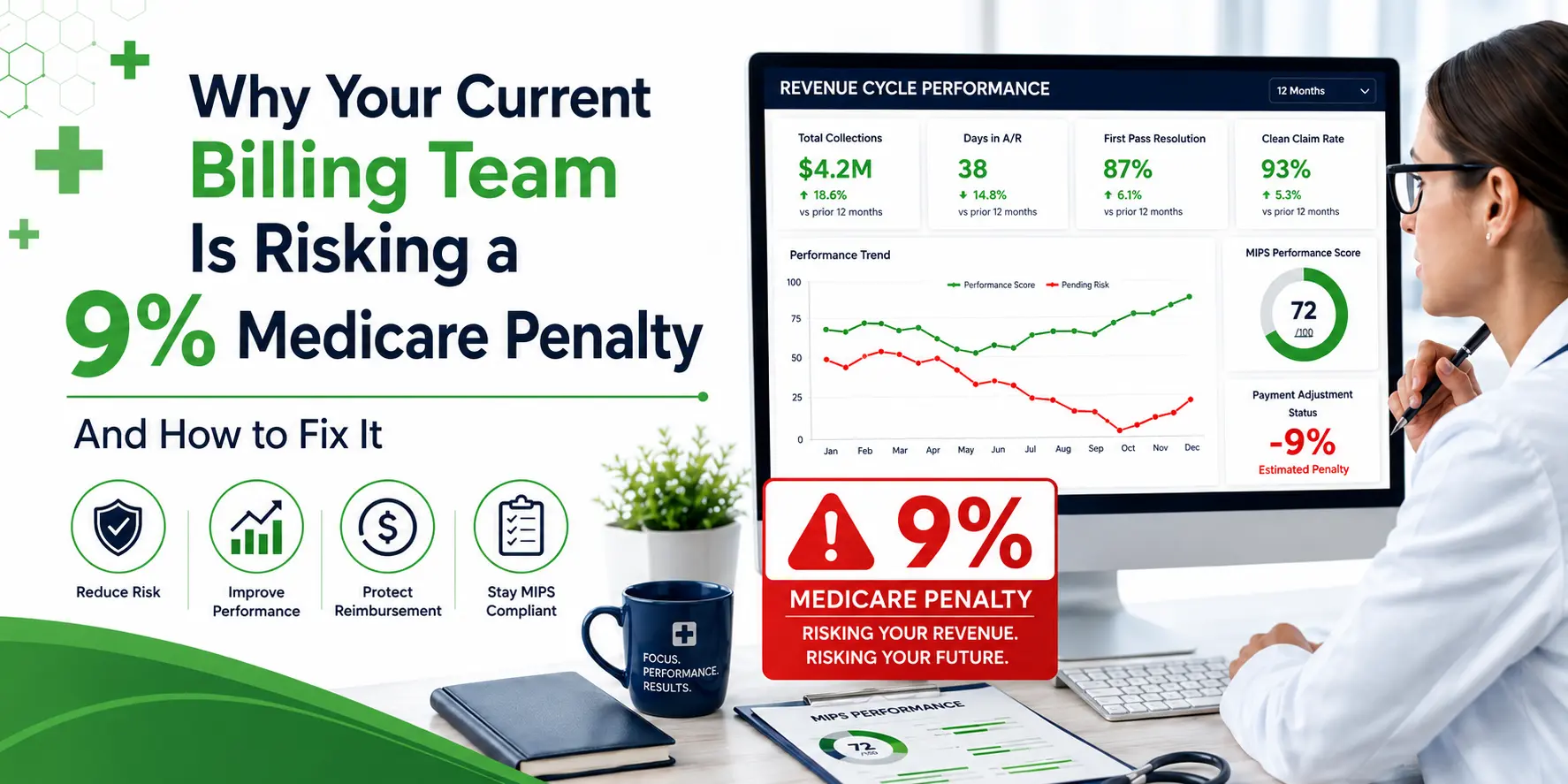
A 9% cut does not sound terrifying until you apply it to real revenue. If your practice bills $500,000 in Medicare Part B reimbursements, a negative 9% MIPS payment adjustment could mean $45,000 in lost revenue. If your Medicare billing volume is $1 million, the risk climbs to $90,000. That is not a paperwork issue. That is payroll, technology, staffing, provider compensation, and growth capital leaving your practice because the right data was not tracked at the right time. The hard truth is that many billing teams are still built for an older healthcare model. Their main job is to submit claims, chase denials management , post payments, and keep accounts receivable under control. Those tasks still matter, but they are no longer enough. Under the Quality Payment Program (QPP), Medicare does not only ask, “Was the claim paid?” It also asks, “Did this provider report quality measures, use Certified EHR Technology, complete improvement activities, manage cost, and meet the MIPS performance threshold?” CMS states that a clinician’s MIPS final score determines the payment adjustment applied to Medicare Part B claims, and the performance year runs from January 1 through December 31. CMS has also set the MIPS performance threshold at 75 points through the 2028 performance year / 2030 MIPS payment year. That means waiting until submission season is a dangerous strategy. By then, the clinical year is already over. Missing quality data, weak EHR mapping, poor measure selection, and unmonitored cost patterns may already be locked in. This guide explains why the gap happens, how to spot the warning signs, and how to move from basic claim submission to a revenue protection model that helps avoid MIPS penalties before they damage your bottom line. Traditional medical billing looks backward. A biller checks whether the encounter was coded, whether the claim was submitted, whether Medicare paid it, and whether any denial needs correction. That process is reactive. It is built around fee-for-service payment. “Protect your Medicare revenue before MIPS penalties affect your bottom line. Contact Advanced IT & Healthcare Solutions today for a Free MIPS & Billing Health Audit. “ MIPS requires a different mindset. It looks forward while care is still being delivered. It asks whether the right data is being captured inside the EHR, whether quality measures are being met, whether the practice is completing improvement activities, whether CEHRT requirements are aligned, and whether the practice is on pace to protect future reimbursement. This is where many practices get exposed. A standard billing team may submit a clean claim for a diabetic patient visit. But did anyone confirm that the A1C was documented in the correct structured field? Did the provider close the care gap? Did the measure flow properly from the EHR into the reporting workflow? Was the patient excluded or included correctly? If those details are missed, the claim may still get paid today while the practice loses MIPS points tomorrow. MIPS also includes a Cost performance category, and this is often misunderstood. Cost is not something your team manually submits at the end of the year. CMS calculates cost measures using Medicare administrative claims data, which means the pattern of services, referrals, utilization, and episode costs can affect scoring without a separate data upload from the practice. A billing team that only focuses on claim status may never review how claims behavior affects the Cost category. They may not see patterns that increase cost attribution. They may not flag referral leakage, avoidable utilization, coding inconsistencies, or episode-based cost exposure. Yet CMS still uses claims data to calculate that category. There are also bonus opportunities that inexperienced teams overlook. For example, clinicians in small practices who submit at least one quality measure can receive 6 bonus points in the quality category.The Complex Patient Bonus can also affect the MIPS final score based on patient complexity and other program rules. The issue is not that billing teams are lazy. The issue is that many were never trained to manage value-based care. They were trained to move claims, not manage a Composite Performance Score. For years, the revenue cycle was simple in theory: document the visit, code it correctly, submit the claim, appeal denials, and collect payment. That was the fee-for-service world. MIPS changes the financial equation. A practice can have strong monthly collections and still be building toward a future Medicare penalty. That is why value-based care vs fee-for-service is not just a policy debate. It is a real operational issue for independent physicians, specialty groups, and healthcare organizations across Texas. The Quality Payment Program rewards practices that can prove performance. That proof depends on data. The data depends on workflows. The workflows depend on your EHR, billing process, compliance oversight, and provider habits working together. If any part breaks, the practice may lose points. For example, your providers may believe they are documenting well, but the EHR may not be capturing the measure in a reportable format. Your billers may think everything is fine because claims are being paid. Your administrator may not know there is a problem because no one is producing a monthly MIPS score estimate. Then, months later, the practice finds out that the Composite Performance Score is lower than expected. That is how practices end up asking how to avoid MIPS penalties when the better question would have been: “Who is monitoring our risk every month?” If your current team cannot answer basic MIPS questions clearly, your practice may be exposed. Use the checklist below as a quick medical billing compliance audit. Your EHR is not just a charting system. It is part of your MIPS reporting infrastructure. Certified EHR Technology, often called CEHRT, affects Promoting Interoperability and can influence how smoothly data is captured, validated, and submitted. If your billing team never asks whether your EHR is certified, whether measure mapping is correct, whether providers are entering data into structured fields, or whether your reporting dashboard matches your selected measures, that is a serious warning sign. A billing company that does not understand CEHRT alignment may still submit claims, but it cannot fully protect you from MIPS Medicare penalty risk. Your Composite Performance Score, now commonly referred to as the MIPS final score, is the number that determines whether you are above or below the performance threshold. CMS explains that your final score is compared with the performance threshold to determine your payment adjustment. If your team cannot tell you your estimated score by quarter, they are not managing risk. They are guessing. A strong billing and compliance partner should be able to review your quality measure progress, improvement activities, Promoting Interoperability status, and cost exposure. They should be able to tell you whether you are comfortably above the threshold, barely safe, or in danger. No practice owner wants to hear, “We’ll know after submission.” That is not revenue protection. That is blind reporting. Last-minute MIPS submission is one of the easiest ways to create avoidable risk. Errors happen. Files fail. EHR reports do not match expectations. Provider exclusions need review. Measure performance may not be what the team assumed. Login access may be outdated. Registry issues may appear. If your team waits until the submission deadline, there may be no time to fix the problem. MIPS should be monitored throughout the performance year, not treated like a once-a-year administrative chore. The best medical billing company in Texas for a Medicare-heavy practice should have a year-round process for QPP readiness, not a panic-based submission calendar. Some teams choose measures because they are simple to pull from the EHR. That may not be the best strategy. A measure can be easy to report and still produce a weak score. A better approach looks at specialty relevance, historical performance, benchmark opportunity, documentation burden, patient mix, exclusions, and provider workflow. The goal is not just to submit. The goal is to submit intelligently. If your team cannot explain why each measure was selected, your practice may be leaving points on the table. Because the Cost category is calculated by CMS from claims, some billing teams ignore it. That is a mistake. You cannot manually submit cost data, but you can influence cost performance through better coding accuracy, care coordination, referral awareness, documentation quality, avoidable utilization review, and claims pattern analysis. Ignoring cost because it is calculated behind the scenes is like ignoring your credit score because someone else calculates it. Small practice bonus. Complex Patient Bonus. Reweighting rules. Hardship exceptions. Category changes. These details can affect your final outcome. CMS notes that certain hardship exception applications may apply when a clinician lacks control over the availability of CEHRT. That type of rule matters. A team that never checks eligibility, exceptions, or bonus opportunities may cost you points that could have helped you avoid a penalty. The obvious cost is the payment adjustment. A low score can reduce future Medicare payments. But the hidden costs can be just as damaging. First, there is staff stress. When MIPS tracking is manual, clinical teams often end up doing spreadsheet work that should have been automated. Nurses, MAs, providers, and office managers waste hours chasing data that should already be visible. “Want to see how better MIPS tracking and billing oversight can reduce revenue risk? Request a demo with Advanced IT & Healthcare Solutions today. “ Second, there is provider frustration. Physicians do not want to be told months later that they failed a measure because a field was not clicked correctly. They need clear workflows during the visit, not after-the-fact blame. Third, there is leadership uncertainty. Practice managers and CFOs need reliable forecasting. If MIPS risk is unknown, Medicare revenue projections become less dependable. Fourth, there is compliance exposure. A weak MIPS process often points to broader revenue cycle weaknesses: poor documentation checks, inconsistent coding review, unclear audit trails, and limited oversight. That is why MIPS should not be viewed as a reporting task. It should be part of your revenue cycle management strategy. The solution is not to fire every biller or buy another dashboard without a process. The solution is to change the operating model. Your practice needs billing, compliance, EHR reporting, and value-based care management working together. That is what a revenue protection model does. It does not only ask, “Did Medicare pay the claim?” It asks, “Are we protecting next year’s Medicare reimbursement too?” Here is how to start. Start with a historical review. Look at your past MIPS scores, payment adjustments, submitted measures, category performance, and reporting methods. Identify where points were lost. Ask these questions: What was our final score last year? Which measures performed poorly? Were any measures submitted with incomplete data? Did our EHR reports match the submitted data? Were we eligible for any bonus points? Did we meet the MIPS performance threshold with room to spare? Did our billing patterns create cost exposure? Were any providers excluded, exempt, or incorrectly included? Did we submit early enough to fix errors? This audit should also include a claims review. MIPS and billing are connected. Coding accuracy, documentation quality, diagnosis capture, modifier use, denial trends, and utilization patterns can all affect revenue integrity. Manual tracking is where many practices fail. If your team depends on spreadsheets, memory, or end-of-year chart reviews, your process is too fragile. Your EHR should help track quality measures in real time or near real time. Providers should know which fields matter. Clinical staff should know how to close care gaps. Administrators should be able to run reports before the year ends. Billing and compliance teams should be able to compare documentation, claims, and quality data. The right technology setup reduces manual burden. It also makes the process less dependent on one employee who “knows how the spreadsheet works.” Technology alone is not enough, though. Many practices own capable EHR systems but still fail because the system is not configured properly. Measure mapping may be wrong. Templates may not match reporting needs. Providers may document in free text instead of structured fields. Reports may not be reviewed until it is too late. That is why CEHRT alignment matters. The tool, the workflow, and the reporting strategy must match. A MIPS score should not be a surprise. Set a monthly or quarterly review cadence. Track quality performance, improvement activity completion, Promoting Interoperability readiness, and cost indicators. Review provider-level gaps. Check whether your selected measures still make sense. Confirm that reports are pulling accurate data. A good internal target is not “barely above 75.” The performance threshold is a minimum safety line, not a comfort zone. Practices should build a cushion because data errors, measure changes, exclusions, and reporting issues can reduce the final score. If your estimated Composite Performance Score is weak in March, you can fix workflows. If you find out after December 31, your options are limited. Modern Medical Billing RCM is not just claims management. It includes documentation support, coding accuracy, denial prevention, payer compliance, quality reporting awareness, and financial forecasting. This is where practices looking for the best medical billing company in Texas should ask better questions during vendor selection. Do not only ask, “What is your collection rate?” Ask: How do you monitor MIPS Medicare penalty risk? Can you review our QPP history? Do you understand Medicare Part B reimbursements? Can you work with our EHR reports? Do you review cost category exposure? Can you help us prepare before the submission deadline? Will you provide monthly risk updates? Do you understand specialty-specific measure strategy? Can you support a medical billing compliance audit? A vendor that cannot answer these questions may be a claims processor, not a revenue protection partner. We focus on the connection between billing accuracy, compliance discipline, and value-based reimbursement readiness. That matters because the practices most at risk are often the ones that assume paid claims mean safe revenue. The submission deadline should be a final checkpoint, not the beginning of the process. Before submission season, your team should already know which measures will be submitted, what the score estimate looks like, whether all improvement activities are documented, whether Promoting Interoperability data is complete, and whether any hardship exception or special status applies. You should also test access early. Confirm QPP credentials, registry access, EHR export formats, provider eligibility, and submission method. Submission errors are much easier to fix when they are found early. Texas practices face the same federal MIPS rules as every other state, but lean teams often make QPP tracking easy to delay. For practices with strong Medicare Part B volume, that delay can create real revenue risk.If your billing vendor does not monitor MIPS, your office manager may become the default MIPS coordinator, which adds stress and increases compliance risk. When searching for the best medical billing company in Texas, choose a partner that understands RCM, value-based care, CEHRT, CPS tracking, and QPP reporting.Advanced IT & Healthcare Solutions helps Texas practices review billing performance, MIPS readiness, and revenue cycle risk before Medicare revenue is affected. To avoid MIPS penalties, your practice must score at or above the MIPS performance threshold, currently set at 75 points through the 2028 performance year / 2030 payment year. The safest approach is to track quality measures throughout the year, confirm CEHRT alignment, complete improvement activities, monitor cost exposure, validate reports early, and avoid last-minute QPP submission. In simple terms: do not treat MIPS as an annual upload. Treat it as a monthly revenue protection process. MIPS is not just a government reporting task. It is a Medicare revenue issue.A billing team that only submits claims may help you get paid this month while leaving next year’s reimbursement exposed. The practices that win under value-based care are the ones that monitor data early, align their EHR workflows, understand QPP rules, and treat MIPS as part of revenue cycle management. MIPS is also designed to be budget-neutral, meaning low performers help fund the positive adjustments of higher performers.In other words, practices that ignore MIPS may be giving up revenue to competitors that manage it better. Do not wait until the CMS submission deadline to find out your practice is at risk of losing 9%. “Contact us today for a Free MIPS & Billing Health Audit to identify your penalty risk, review your billing workflow, and protect your hard-earned Medicare revenue” The MIPS Medicare penalty is a negative payment adjustment applied to future Medicare Part B reimbursements when an eligible clinician or group scores below the required performance threshold. The adjustment is based on the MIPS final score. The MIPS performance threshold is the score clinicians need to meet or exceed to avoid a negative adjustment. CMS has set the threshold at 75 points through the 2028 performance year / 2030 MIPS payment year. Yes, but only if the billing company understands value-based care, QPP reporting, CEHRT workflows, claims-based cost exposure, and compliance auditing. A basic claim submission team may not be enough. Certified EHR Technology helps promote Interoperability and structured data capture. If your EHR setup does not align with your MIPS reporting strategy, your team may miss points even when providers believe they are documented correctly. No. CMS calculates cost measures using Medicare administrative claims data, so practices do not submit separate cost data for that category.Why Your MIPS Final Score Must Be Tracked Before Year-End
The Disconnect Between Standard Billing and MIPS
Why MIPS Cost Scoring Requires More Than Basic Claims Management
Why Fee-for-Service Billing Is No Longer Enough
Why Paid Claims Do Not Always Mean Your MIPS Score Is Safe
Red Flags That Your Billing Team Is Failing You
1. They Never Ask About Your Certified EHR Technology
2. They Cannot Estimate Your Composite Performance Score
3. They Wait Until the Last Minute to Submit Data
4. They Only Report What Is Easy, Not What Is Strategic
5. They Do Not Review Cost Category Exposure
6. They Do Not Know Which Bonuses Apply
The Real Cost of a Poor MIPS Workflow
Why CFOs and Practice Managers Need Clear MIPS Forecasting
The Fix: Shift to a Revenue Protection Model
Step 1: Run an Immediate MIPS and Billing Audit
Step 2: Connect MIPS Tracking to Your EHR Workflow
Step 3: Monitor the Score Throughout the Year
Step 4: Align Billing With Value-Based Care
Step 5: Prepare Before the CMS Submission Deadline
How Texas Practices Should Think About MIPS Risk
How Do You Avoid MIPS Penalties?
Final Takeaway
FAQ
What is the MIPS Medicare penalty?
What is the MIPS performance threshold?
Can a billing company help avoid MIPS penalties?
Why does CEHRT matter?
Is the Cost category submitted manually?