
8 Medical Billing Mistakes to Avoid Before Denials in 2026
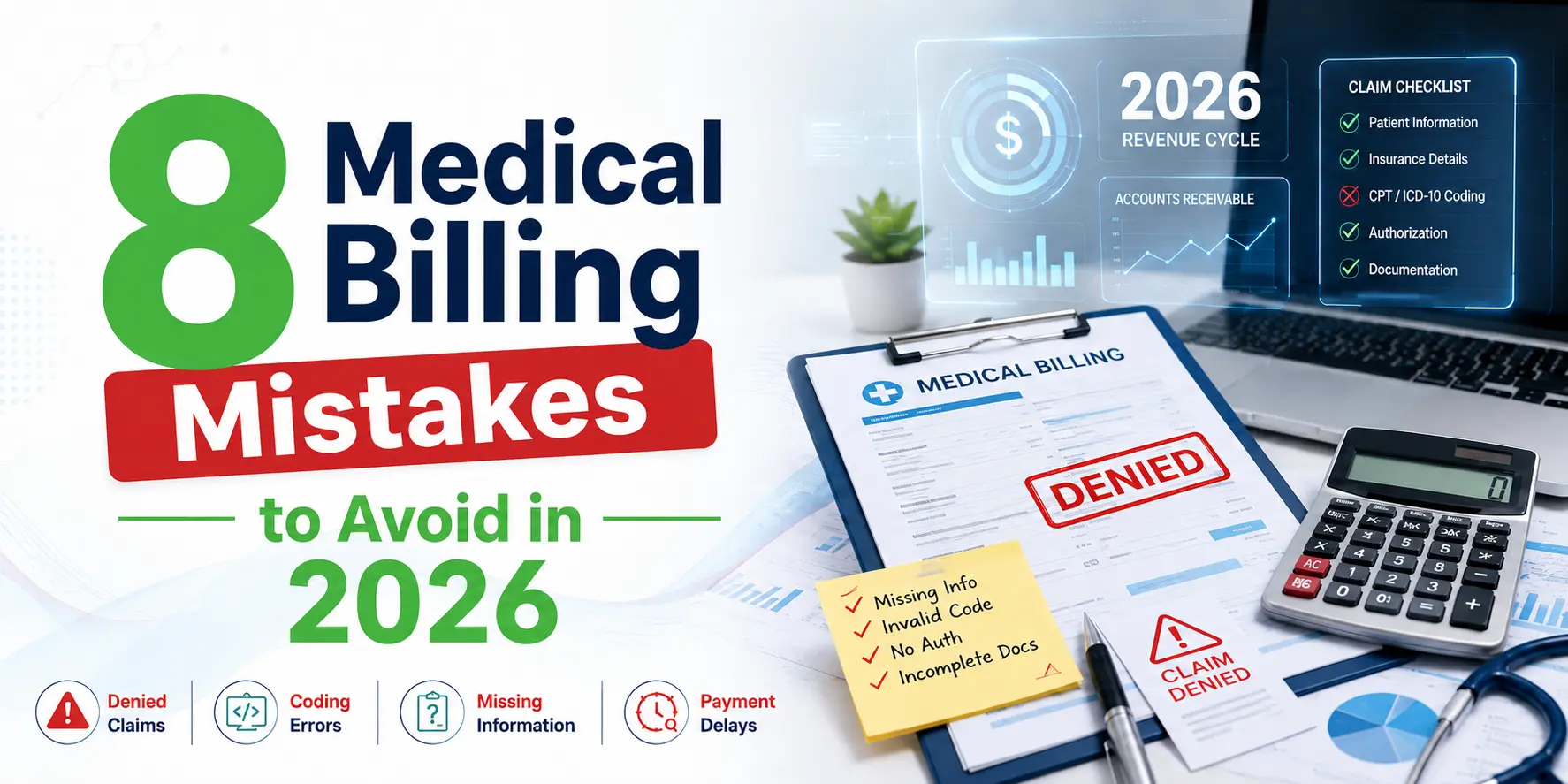
If your denial queue has 63 open claims and half of them trace back to old insurance data, you don't have a coding crisis yet. You have a control problem. The medical billing mistakes to avoid are the dull ones: unchecked eligibility, missing authorizations, stale CPT habits, loose modifier use, late charge entry, duplicate claim resubmission, and denial follow-up that starts after the payer has already trained your staff to give up. Most denials are not born in billing. They start at scheduling, intake, documentation, charge entry, or payer setup. By the time a biller sees CO-16, CO-18, CO-97, or CO-197 on an 835, the practice has already paid for the mistake once in staff time. Then it pays again in days in AR. Advanced IT and Healthcare Solutions looks at these errors as revenue controls, not personality flaws. Your front desk may be doing its best. Your coder may be careful. Your biller may know UHC and Aetna portals better than their own relatives. But if the handoff between them is weak, the payer still wins. The claims that hurt the most usually don't look dramatic. A subscriber date of birth is wrong by one digit. The Blue Cross prefix changed. A prior authorization lives in someone's Gmail folder instead of AdvancedMD or eClinicalWorks. The provider documented a level-four E/M visit but left the medical decision making thin. Nobody checks the NCCI edit before adding a modifier. The most common medical billing mistakes to avoid are old patient data, weak eligibility checks, missing prior authorizations, stale CPT or ICD-10-CM code use, modifier misuse, late claim submission, duplicate claim resubmission, and denial follow-up without reading the payer's 835 response first. Small error. Big mess. A clean claim rate does not improve because everyone promises to be more careful. It improves when the practice blocks preventable defects before a claim leaves the practice management system. A clean claim rate shows how often claims reach the payer with enough accurate information to move through adjudication without avoidable rejection, manual correction, or missing data repair. If Athenahealth, Tebra, NextGen, or DrChrono drops 100 claims and 91 need no payer-side repair, the clean claim rate is 91%. MGMA's 2023 physician practice KPI white paper lists insurance verification rate and clean claim rate as front-end measures practices should track, with a 98% clean claim benchmark in that paper. That number is hard to hit in real life if the front desk still treats insurance cards like a formality. Insurance data goes bad quietly. A patient changes jobs, moves from a commercial Aetna plan to Medicare Advantage, adds a secondary policy, or brings in a card that looks close enough to the old one. The claim gets built on bad ground. We see this with practices that verify coverage once, usually during the first visit, then keep reusing the same demographics for six months. That works until it doesn't. Monday's batch goes out, and by Thursday the billing team is staring at eligibility-related rejections and CO-16-style errors because the payer did not receive what it needed to price the claim. Do not trust old insurance data. Verify eligibility before the visit, again when the patient reports a plan change, and when the payer, subscriber ID, group number, or relationship to subscriber changes. Bad demographics can poison every claim that follows. The fix is not a motivational speech at the front desk. It is a required check inside the intake process: payer name and plan type subscriber ID and group number subscriber date of birth relationship to subscriber effective and termination dates primary and secondary order referral or authorization flag This is where many outsourced billing arrangements fail. The vendor receives a claim file from eClinicalWorks or AdvancedMD and works what it gets. If the patient account is wrong upstream, the billing vendor is cleaning mud off the floor after the pipe burst. Authorization is not billing trivia. For some payers, it is the difference between payment and a dead claim.X12 lists claim adjustment reason code 197 for cases where precertification, authorization, notification, or pre-treatment is absent. That is not a coder being picky. That is the payer saying the service may be payable clinically, but the process was missed. We'd rather see an ugly authorization tracker than a beautiful denial report. At least the tracker catches the problem before the visit. The denial report tells you which money already got stuck. Strong authorization control includes the CPT code requested, payer portal reference number, approval date, expiration date, visit count, rendering provider, facility, and the person who confirmed it. For UHC, Aetna, Cigna, Humana, and BCBS plans, the authorization rule can change by product line. PPO and Medicare Advantage rules may not match. The bad version is familiar: the scheduler asks, "Do we need auth?" Someone says, "I think so." Then the note sits in a Teams message, a sticky note, or a half-filled field in the PM system. That isn't a process. That's hope with a username. Coding from memory is how good billers create bad claims. The provider says it was a level-four visit. The template suggests level four. The prior visit was level four. Then the note doesn't support it. CMS MLN Connects reported in 2025 that 2023 Medicare data showed a 10.7% improper payment rate for evaluation and management codes, with a projected improper payment amount of $3.7 billion. That should make any physician owner pause before saying, "We've always billed it this way." Coding should follow the documentation in the note, not the habit of the provider, coder, or billing manager. E/M level selection, ICD-10-CM diagnosis links, CPT selection, HCPCS codes, and modifiers need a written support trail inside the record. The most painful coding misses tend to sit in plain sight: Diagnosis does not support medical necessity E/M level is higher than the note supports Procedure code does not match the service documented Modifier 25 is used without a clear separate E/M service Modifier 59 is used as a shortcut instead of checking edit logic ICD-10-CM code set was not updated for the current year The AMA's 2025 coding guidance warns physicians about upcoding, unbundling, and errors tied to NCCI edits. The legal tone matters, but the operational point matters too: when coding is loose, your staff gets dragged into rework and your compliance exposure rises. CMS says Medicare NCCI Procedure-to-Procedure edits are built to prevent payment for code pairs that should not be reported together. In a Column One and Column Two edit pair, the Column Two code can be denied unless a proper NCCI-associated modifier is allowed and reported. That sentence is dry. It also explains a lot of denied money. Some practices treat modifier review like a claim scrubber setting. That is not enough. Claim scrubbers help, but they don't know whether the note supports a separate service, a distinct procedural session, a different anatomical site, or a payer-specific rule. We see this most often with modifier 25 and modifier 59. The codes may pass through the EHR. They may even pass the clearinghouse. Then the payer denies one line, requests records, or pays now and questions later. The fix is boring and manual at first. Pick the top 20 CPT pairs by denial amount for the last 90 days. Review the note, modifier, payer, provider, and denial code. If the same provider keeps triggering the same edit, you don't have a billing issue anymore. You have a documentation and training issue. Late filing is one of the dumbest ways to lose earned money because nobody can appeal the calendar into being kinder. CMS's Medicare Claims Processing Manual update issued October 24, 2024 states that Medicare denies a claim for untimely filing when the receipt date exceeds 12 months, or one calendar year, from the date services were furnished, with span-date rules for institutional claims. Commercial payers are often tighter. Some contracts run 90, 120, or 180 days. Charge entry lag should be measured in days, not vibes. If visits from Monday are not entered and reviewed by Wednesday or Thursday, the practice is creating filing risk, appeal risk, and month-end cash noise before the claim is even sent. A practice can have a decent denial rate and still have weak cash because charges sit too long. The owner asks why collections dipped. The billing manager says claims are clean. Both can be true. Clean claims that sit unbilled for 11 days still slow cash. Track these dates: date of service note signed date charge entry date claim created date claim submitted date first payer response date denial worked date If those fields are not reportable in your EHR or PM system, build a simple export. Athenahealth, AdvancedMD, Tebra, NextGen, DrChrono, and eClinicalWorks all have reporting paths, but many teams never set the fields up in a way that lets leadership see the lag. A denied claim is not a request to click resubmit. It is a message. The 835 tells you what the payer did and why, if your team reads the CARC and RARC information instead of guessing. X12 maintains claim adjustment reason codes to explain why a claim or service line was paid differently than billed. CO-16 points to missing information or billing/submission errors. CO-18 is a duplicate claim or service. CO-97 means the service is bundled or already paid under another service. CO-197 points to missing authorization, notification, or pre-treatment. We still see teams work denials by payer portal habit. They open the claim, print the EOB, change one field, and send it again. Then it comes back. Same denial. More aging. More noise. A better denial note says what changed: corrected subscriber date of birth added missing NPI taxonomy attached authorization number corrected modifier based on NCCI review appealed CO-97 with operative note wrote off after contract review and manager approval No note, no learning. Collections are a result. They are not the whole story.A practice can celebrate a good deposit week while the denial queue grows behind the curtain. By the time the cash problem appears, the work problem is already 30 to 45 days old. Track the numbers that show where claims get hurt: clean claim rate first-pass resolution rate denial rate by payer and code days in AR AR over 90 days net collection rate cost-to-collect charge entry lag denial worked within 48 or 72 business hours MGMA's 2025 article on RCM reporting says common measures like days in AR, clean claim pass rate, AR aging, and denial rate are useful trend lines, but they do not always show where work is piling up or why cash is slow. That is the part many dashboards miss. A dashboard that says "denials up 3%" is mildly useful. A dashboard that says "BCBS CO-197 denials rose 28% on CPT 99214 and 20610 for provider Smith after May 1" gets a meeting scheduled. Outsourcing can help. It can also expose how messy the front end really is.Advanced IT and Healthcare Solutions can work claims, denial queues, payment posting, AR follow-up, credentialing tasks, and reporting. But no outside billing team can make a provider sign notes on time from across the internet. Nobody can build a clean claim from a patient account with the wrong payer, wrong subscriber, no authorization, and a note that doesn't support the billed code. A strong RCM partner should push back on weak intake, weak documentation, and weak payer setup. If they only promise faster claim submission, ask what happens when the claims are wrong faster. The right question is not, "Can you bill our claims?" Most vendors can say yes. The better question is, "Where will you stop the mistake before it becomes a denial?" Advanced IT and Healthcare Solutions starts with the claim path, not a sales deck. The review should follow the money from scheduling to payment posting and ask where the practice loses control. A practical review includes: eligibility and demographic checks from the last 30 days authorization misses by payer and CPT CPT, ICD-10-CM, HCPCS, and modifier denial patterns CO-16, CO-18, CO-97, and CO-197 volume charge entry lag by provider days in AR by payer first-pass resolution rate AR over 90 days payment posting accuracy against 835 files appeal notes and write-off approval logic The report should not hide behind pretty charts. If one payer, one provider, one CPT family, or one front-desk field is creating half the pain, say that. For HIPAA and security language, keep it plain and accurate. Do not publish "100% HIPAA compliant." Use claims your team can verify, such as HIPAA-aligned workflows, encrypted PHI handling, role-based access, and audit-ready documentation. If SOC 2 Type II controls are not verified, do not write them. The common mistakes are bad patient data, weak eligibility checks, missing authorization, wrong CPT or ICD-10-CM code selection, modifier misuse, late claim submission, duplicate billing, poor denial notes, and weak payment posting. The expensive part is not always the denial. It is the rework behind it. A billing mistake delays the payer's first clean decision. That pushes the claim into rework, appeal, or correction. If the team waits 14 days to touch the denial, days in AR rises even when the service itself was payable. Start with CO-16, CO-18, CO-97, and CO-197. Those codes catch missing information, duplicate claims, bundled services, and missing authorization. Then review them by payer, provider, CPT code, and dollar amount, not just total count. Sometimes. A low-fee vendor can cost more if denial follow-up is weak or reporting is vague. An in-house biller can cost less if the volume is low and the process is clean. Compare cost-to-collect, denial rate, AR over 90, and manager time before deciding. Monthly is realistic for most practices. Review the top denial reasons, payer trends, charge entry lag, and write-offs every month. Run a deeper coding and documentation review each quarter, especially if E/M, procedure, or authorization denials are rising. No. A claim scrubber can catch missing fields, some edits, and some code conflicts. It cannot fix a note that does not support the code, an authorization that was never requested, or a payer contract rule nobody loaded. The first sign is usually not lower collections. It is rework. Watch for repeat denials, staff touching the same claim more than twice, payer portal calls for missing information, provider complaints about coding queries, and AR buckets getting older.Why Small Billing Errors Lead to Costly Denials
What a Clean Claim Rate Really Means
Mistake #1: Relying on Outdated Patient and Insurance Data
What Goes Wrong with Patient Data
The 8-Point Insurance Verification Checklist
Mistake #2: Letting Prior Authorizations Go Untracked
Why CO-197 Is a Costly Denial Code
Essential Fields for an Authorization Tracker
Mistake #3: Coding from Memory Instead of Documentation
The Six Most Painful Coding Misses
Mistake #4: Ignoring NCCI Edits and Modifier Rules
When Modifier 25 and 59 Go Wrong
Mistake #5: Submitting Claims Late Due to Charge Entry Lag
Five Dates That Expose Charge Entry Lag
Mistake #6: Resubmitting Denials Without Reading the 835
What CO-16, CO-18, CO-97, and CO-197 Mean
What a Strong Denial Note Must Include
Mistake #7: Measuring Only Collections, Not the Work Behind Them
8 KPIs That Predict Collections Health
Mistake #8: Assuming Outsourcing Fixes Poor Front-End Data
What Outsourcing Can and Cannot Fix
How to Audit Your Billing Process for Hidden Mistakes
12-Point Billing Audit Checklist
FAQ
What are the most common medical billing mistakes to avoid?
How do billing mistakes affect days in AR?
Which denial codes should a practice watch first?
Is outsourcing medical billing cheaper than hiring in-house?
How often should a practice audit billing mistakes?
Can a claim scrubber prevent most billing errors?
What is the first sign the billing process is breaking?