
Pain Management Medical Billing Services for Faster Reimbursements
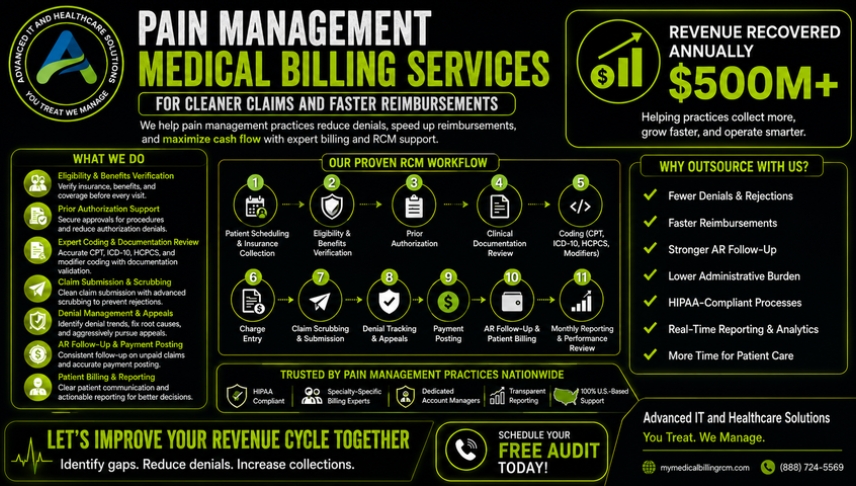
Pain management medical billing services help specialty practices submit cleaner claims, reduce preventable denials, and improve reimbursement speed. For pain clinics, accurate CPT, ICD-10, HCPCS, and modifier use must align with medical necessity documentation, payer rules, prior authorizations, denial management, AR follow-up, and payment posting. A strong billing partner also gives practice owners clearer reporting, so cash flow issues are found before they become long-term revenue loss. Pain management medical billing services are specialty revenue cycle services that manage coding, claim preparation, documentation review, payer submission, denial resolution, payment posting, and patient billing for practices that provide office visits, injections, nerve blocks, ablations, and implant-related procedures. In simple terms, these services turn patient visits and procedures into accurate claims. The workflow includes insurance checks, coding review, documentation review, claim submission, denial handling, payment posting, AR follow-up, and patient billing. For interventional pain practices, small errors can delay payment. A missing modifier, weak diagnosis support, expired authorization, or incomplete medical necessity note can trigger denials. Advanced IT and Healthcare Solutions supports pain management billing and coding with workflows focused on accuracy, compliance awareness, and cash flow. Pain management billing is complex because procedures often require precise CPT, ICD-10, HCPCS, modifier, authorization, and medical necessity alignment. Claims may involve laterality, imaging guidance, bundled services, payer-specific rules, and documentation standards that are stricter than routine office visits. Pain management claims are more complicated than standard office visits because many services are procedural and payer-sensitive. Epidural steroid injections, nerve blocks, facet injections, trigger point injections, radiofrequency ablation, and spinal cord stimulation all require careful billing review. Pain management CPT codes must match the procedure, site, approach, and documentation. ICD-10 codes should support medical necessity. HCPCS codes may apply to certain drugs, supplies, devices, or chronic care services. Prior authorization for pain management is a major bottleneck. Missing approvals, expired authorizations, or mismatched procedure details can cause avoidable denials. Payers may look for symptoms, exam findings, imaging results, failed conservative treatment, pain severity, and functional limitations. Modifiers such as LT, RT, 50, and 59 may affect laterality, bilateral services, and distinct procedural services. Incorrect modifier use can delay or deny payment. Each payer may deny claims differently. Strong denial management for pain management practices tracks denial trends by payer, procedure, provider, and denial code. Pain management billing services usually include eligibility checks, prior authorization support, coding review, charge entry, claim submission, denial appeals, AR follow-up, payment posting, patient billing, and financial reporting to support reimbursement, compliance, and predictable cash flow. Eligibility and Benefits Verification: Confirms active coverage, deductible status, copays, coinsurance, referral rules, and payer-specific requirements before the visit or procedure. Prior Authorization Support: Tracks authorization requests for injections, ablations, spinal cord stimulator services, and other payer-sensitive procedures. Medical Coding Review: Checks CPT, ICD-10, HCPCS, and modifiers against the clinical note, diagnosis support, and payer rules. Charge Entry and Claim Submission: Enters charges accurately and submits clean claims through appropriate payer channels. Denial Management and Appeals: Reviews denial reasons, corrects preventable issues, prepares appeals, and tracks recurring denial patterns. AR Follow-Up and Payment Posting: Follows unpaid claims, posts payments, identifies underpayments, and escalates aging balances. Patient Billing and Reporting: Communicates patient responsibility clearly and gives leadership monthly visibility into revenue cycle performance. Common pain management coding issues involve procedure selection, diagnosis support, medical necessity, laterality modifiers, bundled services, payer rules, and changing CPT, ICD-10, and HCPCS requirements. Practices should verify all coding against current CMS and payer guidance. Pain management billing and coding must be verified against current payer and CMS rules. The following examples are educational only and are not legal, coding, or billing advice. Practices should confirm payer-specific requirements before claims are submitted. Epidural claims may require the correct spinal region, approach, imaging guidance documentation, diagnosis support, and laterality when applicable. Documentation should explain why the injection is medically necessary. Facet and nerve block claims often depend on anatomical level, laterality, diagnostic versus therapeutic purpose, and bundling rules. Modifier mistakes can create repeated denials. Trigger point injections and dry needling may be affected by service type, muscle count, documentation, and payer policy. Notes should make the service and treated areas clear. Spinal cord stimulator billing may involve trial, implant, device, lead, facility, and medical necessity documentation issues. Authorization and documentation should match the submitted claim. Chronic pain management codes such as G3002 and G3003 may be relevant when documentation, time, care planning, and payer requirements support them. Outsourcing pain management billing can improve revenue by reducing preventable denials, accelerating claim follow-up, improving coding review, strengthening prior authorization workflows, lowering administrative burden, improving reporting, and giving providers more time to focus on patient care. An outsourced team can bring specialty focus to pain management medical billing services. Instead of relying on general billing habits, the practice gets structured checks for authorization, documentation, modifiers, payer rules, denials, and aging claims. This can support fewer preventable denials, faster reimbursements, better AR follow-up, lower administrative burden, improved compliance awareness, more consistent reporting, and more time for patient care. “Book a Free Audit with Advanced IT and Healthcare Solutions to identify billing gaps before they become revenue loss.” For pain management practices, the main difference is not only who submits the claim. The larger difference is how consistently the revenue cycle is managed. In-house billing may work when a practice has trained staff, strong coding knowledge, and enough time to follow every claim. However, many pain practices struggle when staff are overloaded, payer rules change, authorizations are missed, or denied claims are not appealed quickly. Outsourced pain management billing can help practices improve prior authorization tracking, coding accuracy, denial management, AR follow-up, compliance awareness, and financial reporting. This is especially important for interventional pain procedures that require accurate CPT, ICD-10, HCPCS, modifier use, and medical necessity documentation. In-house risk: Staff may miss payer-specific prior authorization rules, approval requirements, or expiration dates, especially when the practice handles a high volume of injections, nerve blocks, ablations, or implant-related procedures. Outsourced support advantage: A dedicated billing partner can track prior authorizations before services are performed, verify payer requirements, document approval details, and reduce authorization-related denials. In-house risk: General billers may not fully understand pain management billing and coding rules, including procedure-specific CPT codes, diagnosis support, HCPCS codes, laterality modifiers, bilateral billing, and bundling restrictions. Outsourced support advantage: Specialty billing support can review CPT, ICD-10, HCPCS, and modifier use before claim submission, helping reduce coding errors and improve clean claim performance. In-house risk: Denial appeals may be delayed, incomplete, or inconsistent when internal staff do not have enough time to review denial reasons, gather documentation, and follow payer appeal rules. Outsourced support advantage: A structured denial management workflow can identify denial patterns, correct preventable errors, prepare appeals, track deadlines, and help recover revenue that may otherwise remain unpaid. In-house risk: Aging claims may sit without timely follow-up, especially when staff are focused on front-desk tasks, scheduling, patient calls, or daily claim submission. Outsourced support advantage: Regular AR follow-up can prioritize unpaid claims by payer, age, denial reason, and dollar value, helping practices reduce delays and improve cash flow visibility. In-house risk: Internal teams may miss updates to payer policies, documentation standards, medical necessity rules, coding changes, or HIPAA-related workflow requirements. Outsourced support advantage: HIPAA-aware and payer-aware billing workflows help practices maintain more consistent documentation, claim review, authorization tracking, and revenue cycle processes. In-house risk: Practice owners and managers may lack clear monthly visibility into denial trends, AR aging, collection performance, payer issues, and claim follow-up status. Outsourced support advantage: Transparent reporting and practice analytics can show where revenue is delayed, which payers are creating problems, and which billing issues need correction. In-house risk: Hiring, training, supervision, turnover, software use, and staff coverage can increase administrative costs and create workflow gaps. Outsourced support advantage: Outsourced billing gives pain management practices scalable revenue cycle support without adding full internal headcount, making it easier to manage workload changes and practice growth. Patient scheduling and insurance collection Eligibility and benefits verification Prior authorization Clinical documentation review CPT, ICD-10, HCPCS, and modifier coding Charge entry Claim scrubbing and submission Denial tracking and appeals AR follow-up and patient billing Monthly reporting and performance review Missing medical necessity documentation Incorrect modifiers Missing prior authorization Unbundling errors Outdated codes Weak follow-up on unpaid claims Poor patient responsibility communication No regular billing audit Problem: A pain practice sees repeated denials for injections. Cause: Missing laterality modifier or incomplete documentation. Fix: Review documentation, apply payer-specific medical coding rules, appeal denied claims, and track denial reason trends. Problem: Spinal cord stimulator trial claims are delayed. Cause: Prior authorization details do not match the submitted procedure. Fix: Match authorization, documentation, CPT/HCPCS selection, and payer policy before submission. Problem: AR over 90 days keeps increasing. Cause: Claims are submitted, but follow-up is inconsistent. Fix: Build AR worklists by payer, age, denial reason, and dollar value. A strong pain management billing partner should understand specialty coding, prior authorization, denial appeals, AR follow-up, HIPAA-aware workflows, reporting, payer rules, and practice growth needs while communicating clearly with owners, administrators, and billing managers. Use this checklist before selecting a billing company: Specialty-specific pain billing experience Certified coding support Prior authorization process Denial management workflow AR follow-up system HIPAA-compliant processes Transparent monthly reporting Clear communication Ability to support practice growth Advanced IT and Healthcare Solutions provides practical billing and RCM support for practices that need cleaner claims, better follow-up, and clearer reporting. Services include medical billing and revenue cycle management, virtual medical assistant support, eligibility and benefits verification, prior authorization support, coding support, denial management and appeals, AR follow-up, patient billing, reporting, and practice analytics. The focus is service execution, not hype. For pain management practices, that means building workflows around documentation, authorization, coding, claim submission, denials, and payment recovery. “Schedule your Free Audit today and see where your pain management revenue cycle may be losing money.” Pain management medical billing services manage the revenue cycle for pain practices, including eligibility checks, prior authorization, coding review, claim submission, denial appeals, payment posting, AR follow-up, patient billing, and reporting. Pain management claims are often denied because of missing prior authorization, weak medical necessity documentation, incorrect modifiers, outdated codes, payer-specific policy issues, or coding that does not align with the diagnosis and procedure. Common areas include epidural steroid injections, nerve blocks, facet injections, trigger point injections, dry needling, radiofrequency ablation, spinal cord stimulation, and chronic pain management codes. Codes must be verified against current payer and CMS rules. Outsourcing may be better when a practice lacks specialty coding depth, prior authorization capacity, denial appeal consistency, or AR follow-up discipline. In-house billing may work when the team has strong specialty expertise and reliable reporting. A billing audit can identify denial trends, coding gaps, authorization problems, unpaid claims, documentation weaknesses, modifier errors, and reporting blind spots before they continue damaging cash flow. Pain practices cannot afford slow payments, preventable denials, and unclear AR. Pain management medical billing services give your team a more controlled revenue cycle by improving claim accuracy, documentation checks, prior authorization, denial management, and follow-up. Book a Free Audit with Advanced IT and Healthcare Solutions to find the billing gaps that may be delaying reimbursement and weakening cash flow.What are Pain Management Medical Billing Services?
Why is Pain Management Billing So Complex?
Complex CPT, ICD-10, and HCPCS Coding
Prior Authorization Requirements
Medical Necessity Documentation
Modifier and Bundling Rules
Payer-Specific Denial Patterns
What Do Pain Management Billing Services Include?
Which CPT and ICD-10 Issues Commonly Affect Pain Management Claims?
Epidural Steroid Injection Billing
Nerve Block and Facet Injection Billing
Trigger Point and Dry Needling Codes
Spinal Cord Stimulator Billing
Chronic Pain Management Codes
How Can Outsourcing Pain Management Billing Improve Revenue?
In-House Billing vs Outsourced Pain Management Billing
Prior Authorizations
Coding Accuracy
Denial Appeals
AR Follow-Up
Compliance Tracking
Reporting
Staffing Cost
Step-by-Step Pain Management RCM Workflow
Common Pain Management Billing Mistakes to Avoid
Real-World Examples of Billing Problems and Fixes
How to Choose a Pain Management Medical Billing Partner
Why Advanced IT and Healthcare Solutions
Frequently Asked Questions
What are pain management medical billing services?
Why are pain management claims often denied?
What CPT codes are common in pain management billing?
Is outsourcing pain management billing better than in-house billing?
How can a billing audit help a pain management practice?
Book a Free Audit for Your Practice