
How AIHS Helps Reduce Revenue Leakage in Medical Billing by 20%
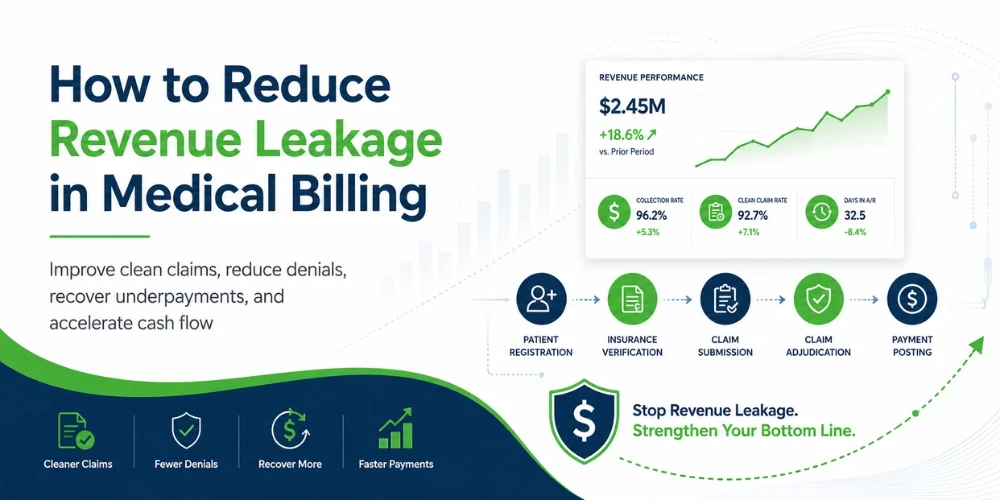
Advanced IT & Healthcare Solutions helps healthcare organizations reduce revenue leakage in medical billing by correcting key breakdowns throughout the revenue cycle. Through smart automation, denial management, coding optimization, underpayment recovery, accounts receivable acceleration, and billing process improvements, AIHS helps practices increase collections, reduce revenue leakage, and achieve stronger long-term profitability. Advanced IT & Healthcare Solutions helps healthcare organizations recover lost revenue by correcting key breakdowns in their revenue cycle management processes. We manage medical billing as an interconnected revenue cycle, combining experienced billing teams, AI-driven technology, and automated workflows. This approach helps reduce denials, recover underpayments, accelerate accounts receivable, improve collections, and support revenue growth of up to 20%. Every clean claim helps reduce revenue leakage in medical billing by supporting faster payments, fewer errors, and stronger cash flow. Certified coding professionals work alongside AI-based validation systems to identify coding errors, missing modifiers, documentation gaps, eligibility issues, and incomplete claim details before submission. This multi-layer review improves claim accuracy, increases first-pass acceptance, reduces costly rework, and helps payments move through the revenue cycle with fewer delays. Preventing a denial before it occurs is far more effective than correcting it after submission. Predictive claim scrubbing analyzes each claim for coding conflicts, authorization problems, eligibility errors, payer-specific rules, and missing patient information. High-risk claims are flagged and corrected before they reach the payer, helping reduce avoidable denials, lower administrative workload, shorten payment cycles, and protect revenue. Denial patterns often reveal the operational gaps causing repeated revenue loss. Effective denial management uses historical claim data, payer behavior, rejection codes, and workflow trends to identify high-risk claims before they are denied. Automated alerts and real-time validation help billing teams fix issues early, improve first-pass acceptance rates, reduce repeat errors, and create a more consistent reimbursement process. A paid claim does not always mean the correct amount was received. Payment data, payer contracts, fee schedules, and expected reimbursement rates are carefully compared to detect underpaid or incorrectly processed claims. Payment differences are investigated, documented, and appealed when eligible, helping recover overlooked revenue, improve payer accountability, and prevent recurring underpayments from affecting profitability. Faster claim submission can make a measurable difference in the speed of reimbursement. Robotic Process Automation handles repetitive billing tasks such as claim creation, data validation, submission, status checks, and follow-up alerts. Reducing manual processing helps prevent delays, improves consistency, limits human error, and allows billing teams to focus on complex claims that require direct attention. Not every outstanding claim carries the same value or recovery potential. Structured accounts receivable intelligence organizes unpaid claims by age, payer, balance, denial reason, status, and likelihood of collection. This data-driven system helps billing teams prioritize high-value accounts, take timely follow-up action, reduce aging balances, recover more outstanding revenue, and maintain healthier cash flow. Identifies Billing Gaps: Reviews the entire revenue cycle to locate coding errors, missed charges, documentation gaps, eligibility issues, and delayed claim submissions. Improves Clean Claim Rates: Combines certified coding expertise with AI-based validation to correct claim errors before submission and increase first-pass acceptance. Prevents Avoidable Denials: Uses predictive claim scrubbing to detect authorization problems, payer-rule conflicts, missing information, and high-risk claims before they reach the payer. Recovers Underpayments: Compares payer reimbursements with contracted rates and fee schedules to identify payment shortages and recover eligible revenue. Accelerates Claim Processing: Uses automated workflows and RPA to speed up claim creation, submission, status checks, and follow-up activities. Prioritizes Outstanding A/R: Organizes unpaid claims by age, balance, payer, denial reason, and recovery potential so billing teams can focus on accounts with the highest value. Tracks Denial Patterns: Analyzes recurring denial reasons and payer behavior to correct workflow weaknesses and prevent the same errors from happening again. Strengthens Cash Flow: Brings coding, automation, denial management, underpayment recovery, and AR follow-up into one connected process to improve collections and reduce revenue leakage. Revenue growth comes from fixing several small leaks that collectively have a major financial impact. Higher clean claim rates increase first-pass approvals, predictive scrubbing reduces preventable denials, and faster claim submission shortens reimbursement timelines. Underpayment detection also helps recover revenue that may have been missed or accepted at an incorrect payer amount. Structured A/R follow-up keeps outstanding claims from aging beyond recovery, while automated workflows reduce manual delays and allow billing teams to focus on complex, high-value accounts. When these improvements work together across the revenue cycle, healthcare organizations can collect more of the revenue they have already earned, strengthen cash flow, reduce administrative costs, and potentially improve overall revenue by up to 20%, depending on existing billing performance and operational gaps. Healthcare organizations can reduce revenue leakage in medical billing by improving claim accuracy, preventing denials, recovering underpayments, and strengthening A/R follow-up. Improving coding accuracy, preventing denials, detecting underpayments, automating claim workflows, and strengthening A/R follow-up helps recover revenue that has already been earned but remains uncollected. We bring these processes together through experienced billing teams, AI-driven validation, and automated workflows. Partnering with a medical billing company in Texas can help healthcare organizations reduce revenue leakage in medical billing, improve collections, and build stronger long-term cash flow. Ready to reduce revenue leakage and improve collections? Contact Advanced IT & Healthcare Solutions today to strengthen your revenue cycle. No. Results depend on the practice’s current billing performance, denial rate, A/R, payer mix, coding accuracy, and existing revenue gaps. The figure represents potential improvement, not a guaranteed outcome. Pricing is generally percentage-based, typically 4% to 8% of collections. The final rate depends on specialty, claim volume, and service needs. There are no setup fees. No. Your practice keeps full visibility and control through regular reports, claim updates, collection data, and performance reviews. Major billing decisions remain with your team. Yes. AIHS can work with many EHR, practice management, clearinghouse, and billing systems. The existing setup is reviewed during onboarding to create an efficient workflow. A strong net collection rate shows that a practice is collecting most of the revenue it is contractually allowed to receive. The ideal rate varies by specialty, payer mix, and patient responsibility.Key Strategies for Turning Revenue Leakage Into Collected Revenue
1. Improving Clean Claim Rates Through Certified Coding + AI Validation
2. Reducing Denials Below Industry Benchmarks Using Predictive Scrubbing
3. Predictive Denial Prevention Strategy
4. Revenue Recovery Strategy Through Underpayment Detection
5. Accelerating Cash Flow Through RPA-Driven Claim Submission
6. Improving Collections Through Structured A/R Intelligence
How AIHS Fixes These Revenue Leaks
Why these Improvements Lead to Up to 20% Revenue Growth
Conclusion
Frequently Asked Questions
Is the 20% revenue increase guaranteed?
What does Advanced IT & Healthcare Solutions charge?
Will we lose control over billing?
Does AIHS integrate with existing systems?
What is a strong net collection rate?