
How to Choose a Revenue Cycle Management Company in Texas
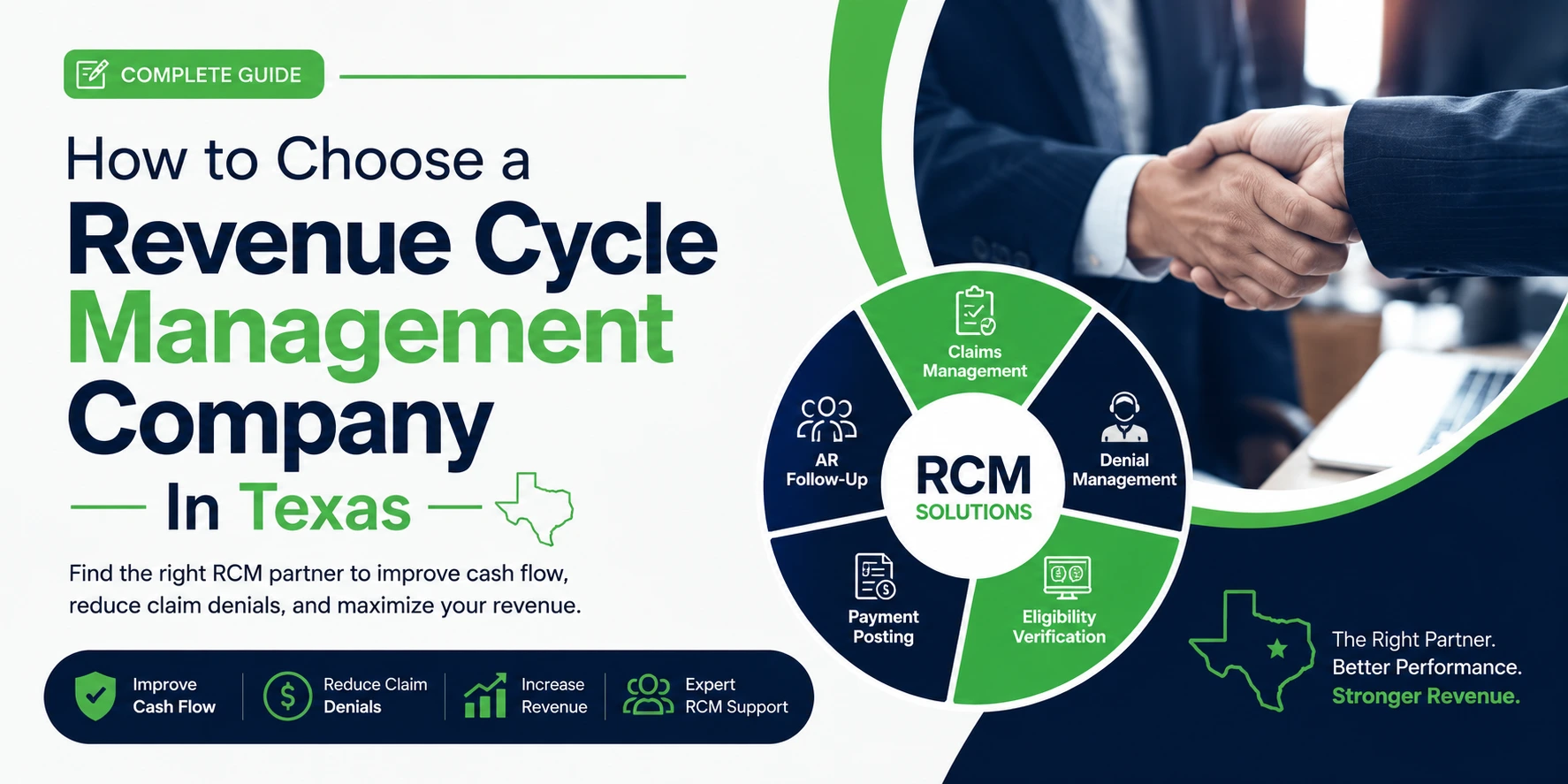
Unworked denials, aging accounts receivable, delayed authorizations, coding inconsistencies, and incomplete payment posting can create cash-flow problems even when patient volume remains stable. These issues are often distributed across the front desk, clinical team, billing staff, clearinghouse, and payer portals, making the underlying cause difficult to isolate. A qualified revenue cycle management company should do more than submit claims. It should establish responsibility across the entire reimbursement process, monitor measurable performance indicators, identify recurring payer and workflow problems, and give practice leadership reliable information for financial decisions. For Texas practices, the selection process should also consider payer mix, Medicaid managed care requirements, specialty-specific authorization rules, geographic coverage, and the needs of single-location, multisite, and ambulatory organizations. A revenue cycle management company in Texas manages administrative and financial processes associated with collecting payment for healthcare services. The work begins before the patient encounter and continues through claim adjudication, payment posting, denial resolution, patient responsibility, and account closure. Medical billing is a central part of RCM, but the full revenue cycle includes eligibility verification, prior authorization, charge capture, coding review, claims management services, payment reconciliation, denial management services, A/R follow-up, credentialing coordination, and performance reporting. A revenue cycle management company coordinates the processes required to convert documented patient services into accurate claims and collected payments. Its responsibilities may include eligibility, authorization, coding, claim submission, payment posting, denial follow-up, A/R management, patient billing, credentialing support, and financial reporting. Front-end errors frequently appear later as claim denials or payment delays. An RCM partner should define how it supports: Patient demographic validation Insurance eligibility and benefit verification Primary and secondary payer identification Referral and prior authorization tracking Provider enrollment status Patient estimate and responsibility workflows Registration error correction Eligibility verification should confirm more than active coverage. Depending on the specialty and service, staff may need to review deductibles, copayments, coinsurance, exclusions, visit limits, referral requirements, authorization requirements, and network participation. Prior authorization workflows should document the requested service, diagnosis, ordering provider, servicing provider, place of service, approved units, authorization number, effective dates, and payer response. A valid authorization does not replace correct coding or medical-necessity documentation, so the process must remain connected to clinical and billing workflows. Medical billing and coding services should include controls between documentation, charge entry, claim creation, clearinghouse acceptance, payer adjudication, and payment posting. The company should explain how it manages: CPT, HCPCS, and ICD-10-CM code assignment Modifier selection Charge reconciliation Claim edits and claim scrubbing Electronic claim submission Clearinghouse and payer rejections ERA and EOB posting Contractual adjustments Secondary claims Credit balances Patient statements Practices should distinguish a clearinghouse rejection from a payer denial. Rejected claims generally fail before adjudication and may require correction and resubmission. Denied claims have been adjudicated but not paid as billed. Each category requires separate tracking because the causes, correction steps, and deadlines differ. The best medical billing company in US for one organization may not be appropriate for another. Evaluation should be based on service scope, specialty knowledge, staffing structure, technology compatibility, reporting, security controls, contract terms, and accountability. Ask the company to provide a responsibility matrix covering every step from scheduling through final account resolution. The document should state whether each task belongs to the practice, the RCM company, or a shared team. Important questions include: Who verifies eligibility and how far before the appointment? Who obtains and tracks authorizations? Who reviews incomplete documentation? Who enters charges? Who owns coding decisions? Who corrects clearinghouse rejections? Who posts ERAs, EOBs, and patient payments? Who works insurance and patient A/R? Who handles refunds and credit balances? Who monitors credentialing and enrollment? Who responds to payer medical-record requests? Undefined responsibilities often create duplicate work or unattended accounts. A healthcare billing company should demonstrate experience with the practice’s actual services, payer mix, coding patterns, and documentation requirements. General billing knowledge may not be sufficient for procedure-heavy, authorization-dependent, facility-based, behavioral health, DME, or multispecialty operations. Request examples of common denials the company sees within the specialty and how it prevents them. The response should address documentation, coding, modifiers, medical necessity, authorization, units, place of service, timely filing, payer edits, and provider enrollment. For a Texas practice, the company should also explain how it monitors commercial payers, Medicare contractors, Medicaid managed care plans, workers’ compensation requirements where applicable, and local plan variations. Determine whether the RCM company works within the practice’s EHR and practice management system or requires migration to another platform. Either model can work, but the contract should identify data ownership, interface costs, system access, user permissions, reporting access, and data-return obligations. The security review should address: HIPAA responsibilities Business associate agreement Role-based access Multifactor authentication Workforce access controls Audit logs Data storage and transmission Incident notification Subcontractor access Access termination The practice should retain sufficient system and reporting access to independently review claims, payments, adjustments, account notes, and outstanding A/R. Effective denial management combines correction, appeal, prevention, and measurement. A company that only resubmits denied claims may recover some revenue but leave the underlying registration, authorization, documentation, coding, or workflow problem unresolved. An RCM company reduces preventable denials by classifying denial reasons, correcting individual claims, identifying recurring causes, and assigning corrective action to the appropriate team. Strong programs monitor denials by payer, provider, location, specialty, procedure, denial code, and workflow source rather than reporting only a total denial percentage. Denials should be categorized using payer messages, Claim Adjustment Reason Codes, Remittance Advice Remark Codes, and internal operational categories. Common categories include: Missing or invalid information Eligibility or coordination-of-benefits problems Authorization absent or inconsistent Noncovered service Medical-necessity denial Coding or modifier issue Duplicate claim Bundling or incidental-service edit Provider enrollment problem Timely filing Medical-record request Payer processing error For example, CO-16 generally indicates that information is missing or invalid, but the accompanying RARC is needed to understand which data element or documentation caused the adjustment. CO-197 generally relates to precertification, authorization, notification, or treatment-plan requirements. Staff should interpret the full remittance message rather than relying on the CARC alone. A denial report should show original billed charges, expected reimbursement, denied amount, corrected amount, recovered amount, appeal status, responsible department, and prevention action. Eligibility and authorization denials should be traced to the point of failure. The cause may be an inactive policy, incorrect payer order, missing referral, wrong servicing location, expired authorization, mismatched procedure code, insufficient approved units, or failure to document a payer call. A reliable workflow includes: Eligibility and benefit review before service Identification of authorization requirements Submission of clinical records Tracking of pending requests Verification of approved codes, units, dates, and location Documentation in the EHR or practice management system Reverification when the treatment plan changes Claim comparison against the authorization record Accounts receivable follow-up should prioritize financial value, filing and appeal deadlines, payer behavior, account age, and probability of collection. Calling payers without defined work queues is not an adequate A/R strategy. The RCM company should segment A/R into current, 31–60, 61–90, 91–120, and over-120-day categories while also reporting aging from both date of service and claim submission date. Work queues may include: Claims never accepted by the payer Claims pending beyond normal processing time Denied claims Claims awaiting medical records Underpaid claims Secondary claims Patient balances Credentialing-related holds Unapplied cash Credit balances Older A/R should not be treated as a single inventory. Accounts should be reviewed for appeal rights, timely filing, authorization evidence, corrected-claim options, documentation availability, payer escalation, patient liability, and appropriate adjustment. Payment posting should compare the payer’s adjudication with contracted or expected reimbursement. A paid claim is not necessarily a correctly paid claim. The RCM process should identify: Incorrect contractual adjustments Missing procedure-line payments Incorrect multiple-procedure reductions Bundling disputes Wrong patient responsibility Recoupments Zero-pay remittances Payments without corresponding remittance data Electronic funds without posted ERAs Reconciliation should connect bank deposits, EFTs, ERAs, paper checks, EOBs, patient payments, and practice management system posting. Outsourcing can provide access to broader billing knowledge, coverage during staff absences, payer follow-up capacity, reporting, and a more variable cost structure. It can also reduce direct responsibility for recruiting, training, supervising, and retaining billing personnel. In-house billing gives the practice direct day-to-day control and may support rapid communication with clinicians and front-office staff. It also requires management capacity, documented workflows, backup coverage, software knowledge, payer expertise, compliance oversight, and performance measurement. Outsourced RCM may be appropriate when a practice lacks billing capacity, has growing A/R, experiences recurring denials, cannot maintain specialist coverage, or needs stronger reporting. In-house billing may remain appropriate when the practice has experienced leadership, stable staffing, documented controls, and consistently measured results. A cost comparison should include more than vendor fees or employee salaries. Practices should evaluate: Salaries and payroll taxes Benefits Recruiting and turnover Training Management time Software and clearinghouse fees Coding resources Compliance support Coverage during leave Office equipment Uncollected revenue caused by workflow gaps A hybrid model may assign eligibility, authorization, coding, or patient communication to the practice while outsourcing claim submission, payment posting, denial management, and A/R follow-up. RCM pricing may be structured as a percentage of collections, a flat monthly fee, a per-claim charge, an hourly fee, or a hybrid arrangement. Industry estimates vary, and practices should compare proposals against their own claim volume, collections, payer mix, specialty, staffing needs, and service scope. The contract should define: Revenue included in the fee calculation Treatment of patient payments Excluded services Coding charges credentialing charges software and interface fees statement and postage costs minimum monthly fees implementation charges contract length renewal terms termination notice data-return requirements ownership of work product responsibility for preexisting A/R post-termination collection fees Avoid evaluating proposals solely by the lowest percentage. A lower fee may exclude coding, authorization, old A/R, patient statements, credentialing, or detailed reporting. Changing billing companies requires claim inventory control, system access, data transfer, payer enrollment review, workflow testing, and clear responsibility for historical A/R. A structured transition should include: Contract and termination review System and data-access assessment Provider, location, payer, and enrollment inventory Existing A/R export Open denial and appeal inventory Authorization and referral review ERA, EFT, and clearinghouse enrollment verification Fee schedule and payer-contract review Workflow and interface testing Parallel monitoring after go-live The transition plan should identify who works claims created before the effective date and who receives fees on later collections. It should also address patient statements, unapplied balances, refunds, medical-record requests, payer correspondence, and appeals already in progress. Cash flow can be protected by reconciling every submitted claim, monitoring clearinghouse acknowledgments, verifying payer acceptance, and comparing post-transition charges and payments with historical patterns. An RCM company should provide reports that permit independent review rather than only presenting favorable summary metrics. Recommended reports include: Charges, payments, and adjustments Claim submission and acceptance Clearinghouse rejection report Denial report by category and payer A/R aging by payer, provider, location, and specialty Days in A/R Clean claim or first-pass acceptance Net collection rate Payment variance and underpayment report Unapplied payment report Credit balance report Authorization status Credentialing status Patient balance report Productivity and account action report Metric definitions should be included because companies may calculate the same KPI differently. Leadership should also receive an explanation of material changes, unresolved risks, corrective actions, responsible parties, and target completion dates. The RCM company should adapt its workflow to the clinical and reimbursement characteristics of each specialty. Primary care billing requires accurate evaluation and management coding, preventive-service distinctions, chronic care workflows, modifier use, payer-specific quality programs, and coordination of multiple diagnoses. Pain management and orthopedic practices commonly require detailed procedure authorization, documentation review, modifier accuracy, laterality, imaging or therapy requirements, drug and supply coding, and careful management of repeat procedures. Behavioral health billing depends on benefit verification, visit limits, telehealth rules, rendering-provider credentials, time-based documentation, authorization requirements, and coordination between medical and behavioral health plans. ASC billing requires facility-specific claim knowledge, procedure and implant charge capture, authorization alignment, payer contract interpretation, multiple-procedure rules, and coordination with professional billing. Cardiology may involve diagnostic testing, global billing rules, technical and professional components, medical necessity, and authorization controls. DME billing requires detailed orders, proof of delivery, continued-need documentation, modifiers, rental rules, and HCPCS-specific requirements. Advanced IT and Healthcare Solutions helps practices identify billing gaps, reduce preventable denials, improve claim follow-up, and create a more consistent revenue cycle process. Support can include: Medical billing Healthcare revenue cycle management Medical billing and coding services Claims management services Denial management Insurance A/R follow-up Prior authorization Eligibility verification Credentialing support Payment posting Billing workflow review Operational reporting The appropriate scope depends on the practice’s specialty, payer mix, systems, staffing model, claim volume, existing A/R, and internal responsibilities. A billing assessment can help determine whether the priority is front-end correction, denial prevention, aged A/R, payment reconciliation, credentialing, reporting, or full outsourced RCM services. Practices evaluating a revenue cycle management company in Texas should request a defined service scope, implementation plan, reporting package, responsibility matrix, and contract review before making a decision. Pricing may be based on a percentage of collections, monthly fee, per-claim rate, hourly charge, or hybrid model. Industry estimates vary. Compare the total scope, exclusions, implementation charges, software expenses, coding fees, statement costs, credentialing fees, and old A/R terms rather than comparing only the headline rate. The appropriate model depends on claim volume, specialty complexity, staff experience, management capacity, software, payer mix, and current performance. Outsourcing may add capacity and specialist knowledge, while an experienced in-house department may provide direct operational control. Practices should compare total costs and measured results. An RCM company should track denial codes, correct affected claims, identify root causes, and change the workflow that created the denial. Prevention may require better eligibility verification, authorization tracking, documentation, coding, charge entry, provider enrollment, or clearinghouse edits. A/R follow-up includes claim-status review, payer contact, denial correction, medical-record submission, corrected claims, appeals, underpayment review, escalation, secondary billing, patient responsibility review, and account documentation. Work should be prioritized according to value, age, deadlines, payer behavior, and collection probability. The timeline depends on system access, data transfer, payer enrollment, clearinghouse setup, ERA and EFT configuration, claim volume, old A/R, and contract termination requirements. A written transition plan should define milestones, claim ownership, testing, reporting, and post-launch reconciliation. Practices should receive reports covering charges, payments, adjustments, claim acceptance, rejections, denials, A/R aging, days in A/R, collection performance, underpayments, unapplied cash, credit balances, authorizations, credentialing, and account activity. Definitions and underlying account details should be available. A multispecialty RCM company can support several specialties when it has trained staff, documented specialty workflows, payer knowledge, coding controls, and appropriate reporting. The practice should verify experience with its procedures, authorization requirements, claim forms, documentation patterns, and common denial categories. Review service scope, fee calculation, excluded work, system access, data ownership, security requirements, subcontractors, implementation charges, contract length, termination terms, preexisting A/R, post-termination collections, performance reporting, escalation procedures, and responsibility for payer enrollment and credentialing.What a Revenue Cycle Management Company Does
Front-End Revenue Cycle Services
Claims, Coding, and Payment Services
How to Evaluate a Revenue Cycle Management Company
Service Scope and Responsibility
Specialty and Payer Experience
Technology, Security, and System Access
Denial Management and Claim Prevention
Denial Classification and Root-Cause Analysis
Prior Authorization and Eligibility Controls
A/R Follow-Up and Payment Delay Management
A/R Aging Work Queues
Underpayments and Unapplied Payments
Outsourced RCM Services vs In-House Billing
Revenue Cycle Management Cost and Contract Review
Medical Billing Company Transition Process
Revenue Cycle Reporting and Performance Transparency
Specialty-Specific Medical Billing Requirements
Primary Care and Internal Medicine
Pain Management and Orthopedics
Psychiatry and Behavioral Health
Ambulatory Surgery Centers
Cardiology and DME
How Advanced IT and Healthcare Solutions Can Help
Frequently Asked Questions
How much does a revenue cycle management company cost?
Is outsourcing medical billing better than keeping it in-house?
How does an RCM company reduce claim denials?
What is included in insurance A/R follow-up?
How long does it take to switch medical billing companies?
What reports should an RCM company provide?
Can one RCM company support multiple medical specialties?
What should a practice review before signing an RCM contract?