
Revenue Cycle Management in Healthcare - A Practice Guide
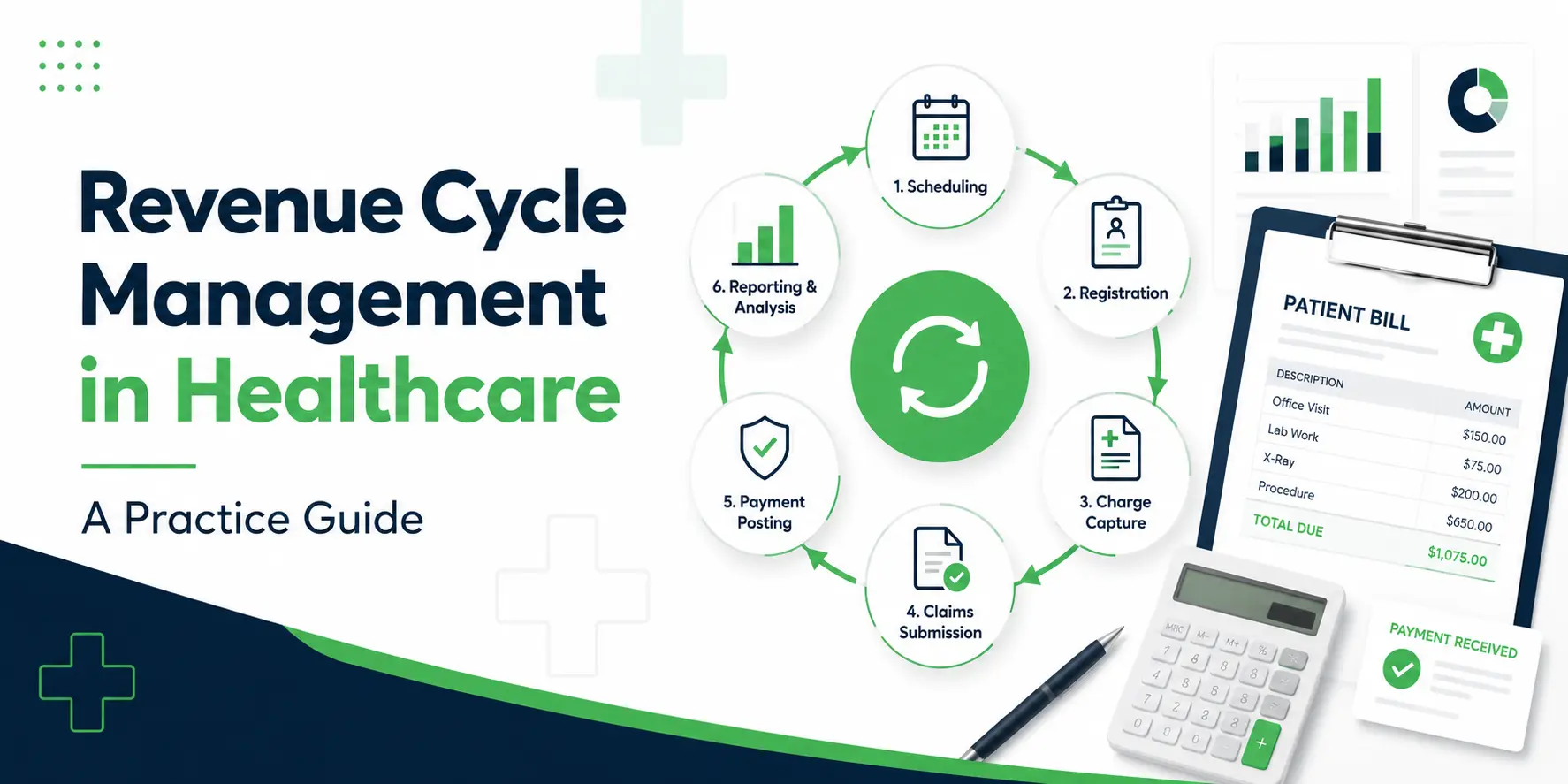
When a practice's claim denial rate rises, days in A/R increase, or collections fall short of projected revenue, the problem rarely traces back to a single error. It typically reflects a systemic gap somewhere in the revenue cycle, a prior authorization that was missed, a procedure code that was not supported by documentation, a payer rule that changed without notification, or a denied claim that was never followed up on. Revenue cycle management in healthcare is the administrative and financial process that moves a clinical encounter from patient registration to final payment. Every stage of that process, eligibility verification, charge entry, claim submission, payment posting, and A/R follow-up, directly affects how much a practice collects and how efficiently it collects it. Understanding how these stages connect is the starting point for identifying where revenue is being lost. Revenue cycle management (RCM) in healthcare refers to the end-to-end process practices and health systems use to manage the financial lifecycle of a patient encounter, from the moment a patient contacts the office to when the balance on that account is fully resolved. Revenue cycle management in healthcare covers every administrative step tied to patient billing and reimbursement, including insurance eligibility verification, prior authorization, medical coding, claim submission, payment posting, denial management, and A/R follow-up. Practices manage RCM internally, outsource it to a best medical billing company in Texas, or use a combination of both. The goal is accurate, timely reimbursement for services provided. The term applies to independent physician practices, group practices, hospital systems, ambulatory surgery centers, and other provider organizations. While scale and complexity differ, the core financial workflow is consistent: submit an accurate claim, receive correct payment, resolve unpaid balances, and track outcomes through measurable reporting. The revenue cycle is not a single process, it is a sequence of dependent steps, each of which can introduce error, delay, or financial loss if it is not managed correctly. The revenue cycle begins before the patient is seen. Accurate demographic data, name, date of birth, insurance ID, and referring provider information, directly affects whether a claim can be submitted and processed. Eligibility verification confirms active coverage, benefits, deductibles, and authorization requirements before the appointment takes place. When eligibility is not verified in advance, practices risk submitting claims to inactive plans, billing patients for balances that insurance should have covered, or missing authorization requirements that will result in denial. Many procedures, imaging studies, and specialist referrals require prior authorization from the payer before the service is rendered. A missing or incorrectly submitted prior authorization is one of the most common causes of initial claim denials in procedure-heavy specialties such as pain management, orthopedics, and cardiology. Prior authorization is the process by which a provider requests advance approval from a payer for a specific service. CARC code CO-197 indicates that a precertification, authorization, or referral was absent or invalid. Practices that do not have a defined workflow for tracking authorization status and expiration dates risk losing reimbursement on services that have already been delivered to the patient. Medical necessity documentation supports both the authorization request and the claim. When the clinical documentation in the medical record does not support the coded diagnosis and procedure, payers deny based on lack of medical necessity, typically under CO-50, which often requires a formal appeal with supporting clinical records. Charge entry is the process of translating clinical documentation into billable codes, CPT procedure codes, ICD-10-CM diagnosis codes, and applicable modifiers. Coding accuracy determines whether a claim is paid correctly, denied, or underpaid by the payer. Claim scrubbing is the automated or manual review of a claim before it is submitted to the clearinghouse or payer. A well-configured claim scrubbing process identifies errors before they reach the payer, which improves the clean claim rate and reduces the administrative cost of rework and resubmission. Payment posting applies payer payments, patient payments, and contractual adjustments to the correct patient accounts. Accurate payment posting is necessary for correct A/R reporting, identifying underpayments against contracted rates, and ensuring that secondary billing is triggered when applicable. Denial management involves reviewing denied claims by CARC and RARC codes, determining whether to appeal or write off, submitting corrected claims where appropriate, and tracking denial patterns by payer, code, and provider. Identifying which denials are preventable, versus clinical or coverage-based, is the foundation of a denial reduction strategy. A/R follow-up is the process of contacting payers on unpaid claims, tracking balances across aging buckets, and resolving accounts that are 30, 60, 90, or 120 days outstanding. The longer a claim ages without resolution, the lower the probability of collecting the full amount owed. Days in A/R, the average number of days it takes to collect payment after a service is provided, is a primary benchmark for revenue cycle performance. According to MGMA benchmarking data, many physician practices target a day in A/R figure of 40 days or fewer, with top performers often achieving 30 days or less. A claim denial is a payer's refusal to reimburse for a submitted service. Denials may be administrative (missing information, authorization errors, timely filing), clinical (medical necessity, excluded service), or contractual (bundling, modifier inconsistency). Industry estimates on denial rates vary widely across practices and specialties. Practices should review their own clearinghouse and payer reports to establish a baseline denial rate and track whether it is improving over time. CARC (Claim Adjustment Reason Codes) and RARC (Remittance Advice Remark Codes) are published by the Washington Publishing Company (WPC) and used across Medicare, Medicaid, and commercial payers to identify the specific reason a claim was denied or adjusted. Frequently encountered denial codes include: CO-16: Claim or service lacks information or has submission/billing errors. Often caused by missing required fields, an invalid NPI, or incorrect patient demographic data. This is commonly a preventable denial correctable through claim scrubbing and staff training. CO-197: Precertification, authorization, or referral was absent, incomplete, or not obtained. Indicates a prior authorization failure. Depending on payer rules and applicable state law, retro-authorization may or may not be available after the service has been rendered. CO-4: The procedure code is inconsistent with the modifier used. Common in procedure-heavy specialties where modifier usage must align with payer-specific billing policies, particularly for services billed with modifiers 25, 59, or 51. CO-50: Non-covered service because the payer determined the service is not medically necessary. Requires documentation review and, in most cases, a formal appeal with supporting clinical records from the treating provider. Tracking denials by code and payer allows billing teams and RCM companies to identify systemic patterns, target corrective action, and measure whether denial rates are declining over time. A/R aging reports categorize outstanding balances by the length of time since the date of service or initial claim submission, typically organized into buckets of 0–30, 31–60, 61–90, 91–120, and 120+ days. The distribution of balances across these buckets reflects the efficiency of the billing and follow-up process. A high concentration of balances in the 90-day or 120-day buckets typically indicates one or more of the following: delayed claim submission, inadequate follow-up on unpaid claims, unresolved denials that have aged without appeal, or payer-specific processing delays that have not been escalated. For most specialty practices, balances aged beyond 120 days carry a significantly lower recovery rate than balances addressed within the first 60 days. HFMA and MGMA both publish A/R performance benchmarks by practice type and specialty. Practices should compare their performance to specialty-matched benchmarks rather than general industry averages, as days in A/R can vary substantially between a primary care practice and a cardiology or orthopedic group. The decision to manage billing internally or outsource to an RCM company depends on practice size, billing volume, staff capacity, current denial rate, and the complexity of the payer mix. In-house billing gives practices direct control over the billing workflow and daily access to billing staff. However, it also introduces fixed overhead costs, salary, benefits, coding education, software licensing, and the disruption of staff turnover. When a billing staff member leaves, the impact on claim submission timelines and A/R follow-up can be immediate. Outsourced revenue cycle management transfers billing operations to a specialized company with dedicated staff, coding expertise, and denial management workflows. The cost structure typically shifts from fixed staff overhead to a percentage of collections or a per-claim fee. For practices with variable patient volume, a high denial rate, or limited internal billing expertise, outsourcing may reduce administrative burden and support more consistent revenue cycle performance. Advanced IT and Healthcare Solutions works with physician practices, billing managers, and practice administrators to support the full revenue cycle, from eligibility verification and prior authorization tracking to charge entry, claim submission, denial management, A/R follow-up, and payment posting. The company helps practices identify billing gaps, address preventable denial patterns, improve claim follow-up timelines, and develop more consistent reporting processes. Services are structured to support independent practices and specialty groups that need reliable billing support without the cost of a fully in-house billing operation. For practices that are seeing increased claim denials, growing A/R aging balances, or disruption from billing staff turnover, Advanced IT and Healthcare Solutions provides a structured review of current billing performance and a practical plan for addressing the areas where revenue is being affected. Medical billing typically refers to the process of submitting claims and posting payments. Revenue cycle management is a broader term that covers the full financial workflow, from patient registration and eligibility verification through prior authorization, coding, claim submission, denial management, A/R follow-up, and performance reporting. RCM encompasses medical billing but also includes process oversight, payer contract management, and measurable outcome tracking. Days in A/R benchmarks vary by specialty and payer mix. According to MGMA benchmarking data, many physician practices target a days in A/R figure below 40 days, with top-performing practices often achieving 30 days or fewer.Practices with a high volume of Medicare, Medicaid, or workers' compensation claims may see different results than those with predominantly commercial payers. A billing transition typically requires 30 to 90 days, depending on the complexity of the practice, the EHR and practice management system in use, and the volume of outstanding A/R being carried over. During onboarding, the RCM company should map existing workflows, establish access to the billing system, review payer contracts, and assess current denial and A/R reports before assuming full billing operations. Practices should confirm that the transition plan addresses outstanding claims and aging balances, not just future billing. An RCM company should provide regular reporting that includes: clean claim rate, denial rate by payer and denial code, days in A/R, collections by payer and provider, A/R aging by bucket, and appeal resolution rates. Monthly reporting is standard; some companies provide weekly or real-time dashboard access. Practices should clarify reporting frequency, format, and access rights before entering a service agreement. Yes. Independent practices, including single-provider offices, small group practices, and specialty practices, often benefit from outsourced RCM because they may not have the billing staff volume or denial management expertise to manage complex payer rules and follow-up workflows internally. Small practices should look for RCM companies with experience in their specific specialty, familiarity with their payer mix, and transparent reporting that does not require a high minimum claim volume to access. When a service requires prior authorization and the practice does not obtain it, obtains it under the wrong procedure code, or fails to track its expiration date, the resulting claim is typically denied with CARC code CO-197. Depending on payer rules and applicable state regulations, retro-authorization may or may not be available after the service has been rendered. The most effective approach is a defined pre-service authorization workflow that confirms authorization status and procedure code alignment before the patient appointment is scheduled. A clean claim is a claim that is submitted with all required information, correct diagnosis and procedure codes, matching patient demographic data, and valid payer-specific requirements and that passes clearinghouse and payer edits without errors requiring correction. A clean claim rate of 95% or above is generally considered a strong benchmark, though practices should verify this against their own clearinghouse acceptance reports and establish a baseline before comparing to industry figures. What Is Revenue Cycle Management in Healthcare?
The Core Stages of the Healthcare Revenue Cycle
Patient Registration and Eligibility Verification
Prior Authorization and Medical Necessity Review
Charge Entry, Coding, and Claim Submission
Payment Posting and Denial Management
A/R Follow-Up and Collections
How Claim Denials Affect Practice Revenue
Common Claim Denial Codes and Their Impact on Practice Revenue
A/R Aging and Days in A/R Benchmarks for Medical Practices
In-House Billing vs Outsourced Revenue Cycle Management
How Advanced IT and Healthcare Solutions Supports Practice Revenue Cycles
FAQs
What is the difference between medical billing and revenue cycle management?
What are good days in A/R benchmark for a medical practice?
How long does it take to transition to an outsourced RCM company?
What reports should a revenue cycle management company provide?
Can a small or independent practice benefit from outsourced revenue cycle management?
How do prior authorization failures lead to claim denials?
What is a clean claim in medical billing?