
Why Underpaid Medical Claims Slip Past Your A/R Report
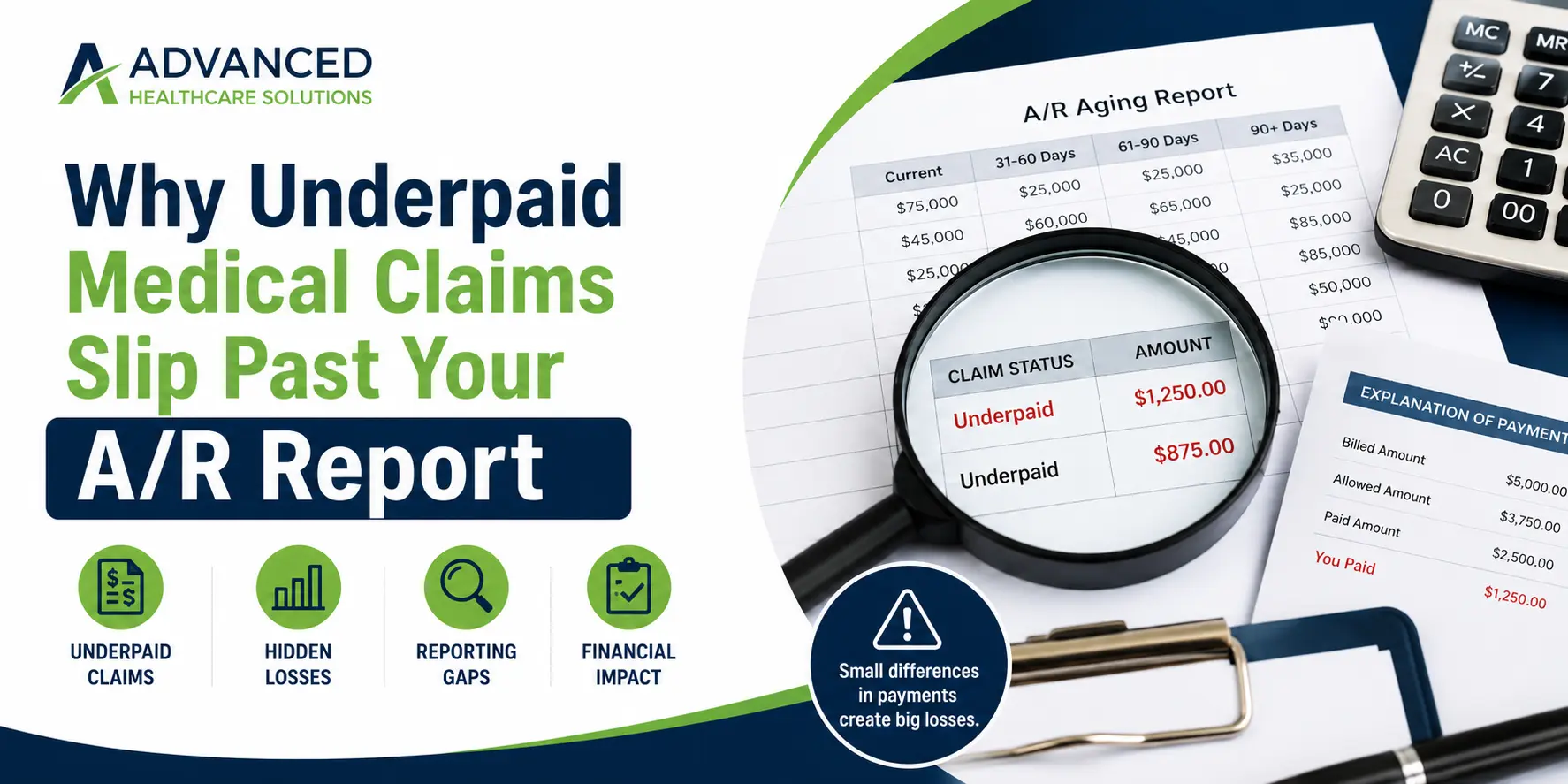
Your A/R report may show what is unpaid. But it may not show what was underpaid. That is why practices can have active collections and still miss revenue.For most physicians and practice owners, the A/R aging report is the trusted dashboard for revenue health. Buckets are reviewed, denials are worked, follow-ups are documented, and collections percentages are tracked. On paper, the billing operation looks active. Claims are moving. Money is coming in. And yet, revenue can still be quietly leaking not from the unpaid column, but from the paid one. This is the part of the revenue cycle that often goes unexamined: claims that were paid, but not paid correctly. Underpayments, silent contract reductions, modifier-driven write-downs, and prematurely closed accounts can all sit invisibly inside a healthy-looking A/R report. The result is a practice that thinks it is collecting well, while leaving recoverable dollars on the table month after month. This article explains why that happens, what to look for, and how a focused review of payment accuracy, not just aging can help close the gap. A traditional accounts receivable report tells you which claims have been submitted, which are still open, and how long they have been sitting in each aging bucket typically 0–30, 31–60, 61–90, 91–120, and over 120 days. It is a snapshot of money that has been billed but not yet collected. That is genuinely useful. A/R management is foundational in medical billing. Without it, claims fall into the void, denials go unworked, and timely filing windows close. A clean aging report signals discipline. But aging is a measure of time, not accuracy. It tells you how long a claim has been outstanding. It does not tell you whether the dollars that came in actually matched what the claim should have paid. Most A/R reports treat a paid claim as a closed claim. Once payment is posted and the patient balance (if any) is billed out, the claim is removed from the working queue. From the report's point of view, the work is done. What the report typically does not show: Whether the payment matched the contracted allowable Whether multiple-procedure or modifier reductions were applied correctly Whether bundling logic was used appropriately by the payer Whether sequestration, fee schedule changes, or policy edits affected the payment Whether the EOB included a silent denial line buried inside a paid claim Whether the appeal window has already started counting down In other words, the A/R report is excellent at flagging unpaid claims and reasonable at surfacing denied claims. It is generally not built to flag underpaid claims. These three terms get used interchangeably, but they are not the same thing and the distinction matters. Unpaid claims are claims that have been submitted but have not yet received any adjudication response. They sit in aging buckets waiting for a remit. Denied claims have been adjudicated and rejected for a stated reason coding, eligibility, authorization, medical necessity, timely filing, and so on. Denial management focuses on these. They are visible because they carry a denial code. Underpaid claims are the most easily overlooked of the three. The claim was processed. A payment was issued. From the system's perspective, it adjudicated successfully. But the amount paid was lower than the contracted rate, the fee schedule, or the expected reimbursement based on the codes billed. There may be no denial code, no flag, and no follow-up trigger, just a quiet shortfall. Most billing software is built to chase unpaid and denied claims. Far fewer workflows are built to scrutinize whether paid claims were paid correctly. Healthcare revenue leakage rarely comes from one dramatic source. It usually comes from many small, recurring shortfalls that compound over months. Some of the most common drivers include: Contract reimbursement drift. Payer fee schedules are renegotiated, but internal expected-pay tables are not always updated to match. Payments come in below contract, and no one notices because there is no system comparing the two. Modifier reductions applied incorrectly. Modifiers like -51, -59, -50, and -25 affect how procedures are paid. Misapplied multiple-procedure reductions or bilateral adjustments can quietly shrink payments. Bundling and unbundling decisions by the payer. A code that should have paid separately gets bundled into a primary procedure. The payment looks reasonable in isolation, but the claim was actually under-reimbursed. Missed appeal windows on partial payments. Many payers have 90- or 180-day appeal limits from the date of the EOB. A claim that was underpaid in March may already be unappealable by the time anyone notices. Closed paid claims. Once a claim posts as paid, most workflows close it. If a portion of the billed services was silently reduced or written off, the underpayment is now buried in archived data. EOB posting shortcuts Auto-posting can mask line-item denials inside otherwise paid claims, especially when contractual adjustments are taken without review. None of these issues will appear on a standard aging report. They live inside the EOBs and remits, not the A/R bucket. Underpayment risk is not equal across specialties. Higher-complexity, higher-RVU, and procedure-heavy practices tend to carry more exposure simply because there are more variables in each claim. Pain practices need physician billing services that understand multi-procedure sessions involving fluoroscopic guidance, bilateral injections, radiofrequency ablations, and time-based evaluation codes. Multiple-procedure reductions, bilateral modifier handling, and same-day E/M billing with modifier -25 can create silent payment shortfalls when claims are not reviewed carefully. A single misapplied reduction across high-volume injection codes may seem small at first, but it can add up quickly across a month and reduce overall practice revenue. Orthopedic surgical claims involve global periods, staged procedures, hardware and implant components, and frequent use of modifier -59. Bundled denials inside paid surgical claims, missed implant carve-outs, and global period miscalculations are common underpayment patterns. The claim may pay just not for everything that was performed. ASC reimbursement depends on payment indicators, multiple-procedure discounting rules, and implant invoice attachments. Implants billed without proper invoice documentation may be reduced or denied at the line level while the rest of the claim pays. Because the overall claim shows payment, these line-level shortfalls often go unreviewed. These are not edge cases. They are routine billing patterns where small accuracy gaps create steady leakage. Consider a closer review if any of the following sound familiar: Collections percentages look stable, but net revenue per visit has drifted downward Payments from a specific payer feel "off" but no one can point to a denial trend Posters are using auto-adjustments without a secondary review step The practice has not had a payer contract reimbursement review in over a year Modifier-heavy claims (pain, ortho, surgery) are not audited separately Appeal volumes are low which can indicate underpayments are not being caught, not that they are not happening Paid claims are closed automatically once a payment posts A complete payment accuracy review goes deeper than aging buckets. A practical checklist: Compare actual payments to contracted allowables on a sample of recent paid claims Audit modifier-driven claims (-25, -51, -59, -50, -RT/-LT) for correct payment application Pull a sample of EOBs and review line-by-line, not just total paid Identify payers with a pattern of bundling or reducing specific code combinations Review timely appeal compliance on partially paid claims Spot-check auto-posted contractual adjustments against fee schedules Reconcile fee schedule updates with internal expected-pay tables at least annually This kind of review is sometimes called a paid claims audit, payment accuracy review, or claims underpayment review. The terminology varies. The intent is the same: confirm that what was paid matches what should have been paid. A focused revenue leakage review is a structured look at paid claims, not unpaid ones. It is designed to surface patterns that A/R aging cannot payer-specific reductions, modifier handling issues, and contract drift. Findings are typically organized by payer, code, and dollar exposure, so a practice can decide where to focus appeals, contract conversations, or internal workflow changes. It does not replace A/R management. It complements it. A practice can run strong collections and still benefit from a payment accuracy layer underneath. For specialty practices like pain management, orthopedics, surgery centers, and other procedure-heavy environments this kind of review is often where the most meaningful findings show up. A clean A/R report is a sign of disciplined billing operations. It is not, on its own, a sign of full revenue capture. The two questions are different. Did we get paid? is an aging question. Did we get paid correctly? is an accuracy question. Both deserve attention. If your billing operation is focused mostly on the first, it may be worth taking a closer look at the second. Want to know what your A/R report may be missing? Request a free revenue leakage review. A denied claim is one the payer rejected with a stated reason code, typically requiring correction or appeal. An underpaid claim was processed and paid, but at a lower amount than the contracted rate or expected reimbursement. Underpaid claims often have no denial flag, which is what makes them easy to miss. Yes. Collections percentages measure how much of billed revenue is collected against expected pay. If the expected-pay benchmark itself is inaccurate for example, because a payer is silently underpaying collections can look strong while revenue is still being lost. A contract reimbursement review is generally recommended at least once per year, and any time a payer issues fee schedule updates, policy bulletins, or contract amendments. Practices in procedure-heavy specialties may benefit from more frequent reviews. A paid claims audit is a structured review of claims that have already been paid, focused on whether the payment amount matches the contracted allowable and whether modifiers, bundling, and adjustments were applied correctly. It is distinct from a denials audit, which focuses on rejected claims. Procedure-heavy specialties with frequent modifier use including pain management, orthopedics, spine, and ambulatory surgery centers often carry higher underpayment exposure simply because there are more variables in each claim where accuracy can drift. No. A revenue leakage review can be conducted independently of who currently handles the practice's day-to-day billing. It is typically positioned as a diagnostic, not a transition.What an A/R Report Actually Shows
What an A/R Report May Not Show
The Difference Between Unpaid, Denied, and Underpaid Claims
Why Paid Claims Can Still Leak Revenue
Common Underpayment Issues in Specialty Practices
Pain Management Billing
Orthopedic Billing
Surgery Center Billing
Warning Signs Your A/R Report May Be Missing Revenue Leakage
What Practices Should Review Beyond A/R Aging
How a Revenue Leakage Review Helps
Conclusion
Frequently Asked Questions
What is the difference between an underpaid claim and a denied claim?
Can a practice with strong collections still have revenue leakage?
How often should a practice review payer contract reimbursement?
What is a paid claims audit?
Which specialties tend to have the highest underpayment exposure?
Does a revenue leakage review require switching billing companies?